
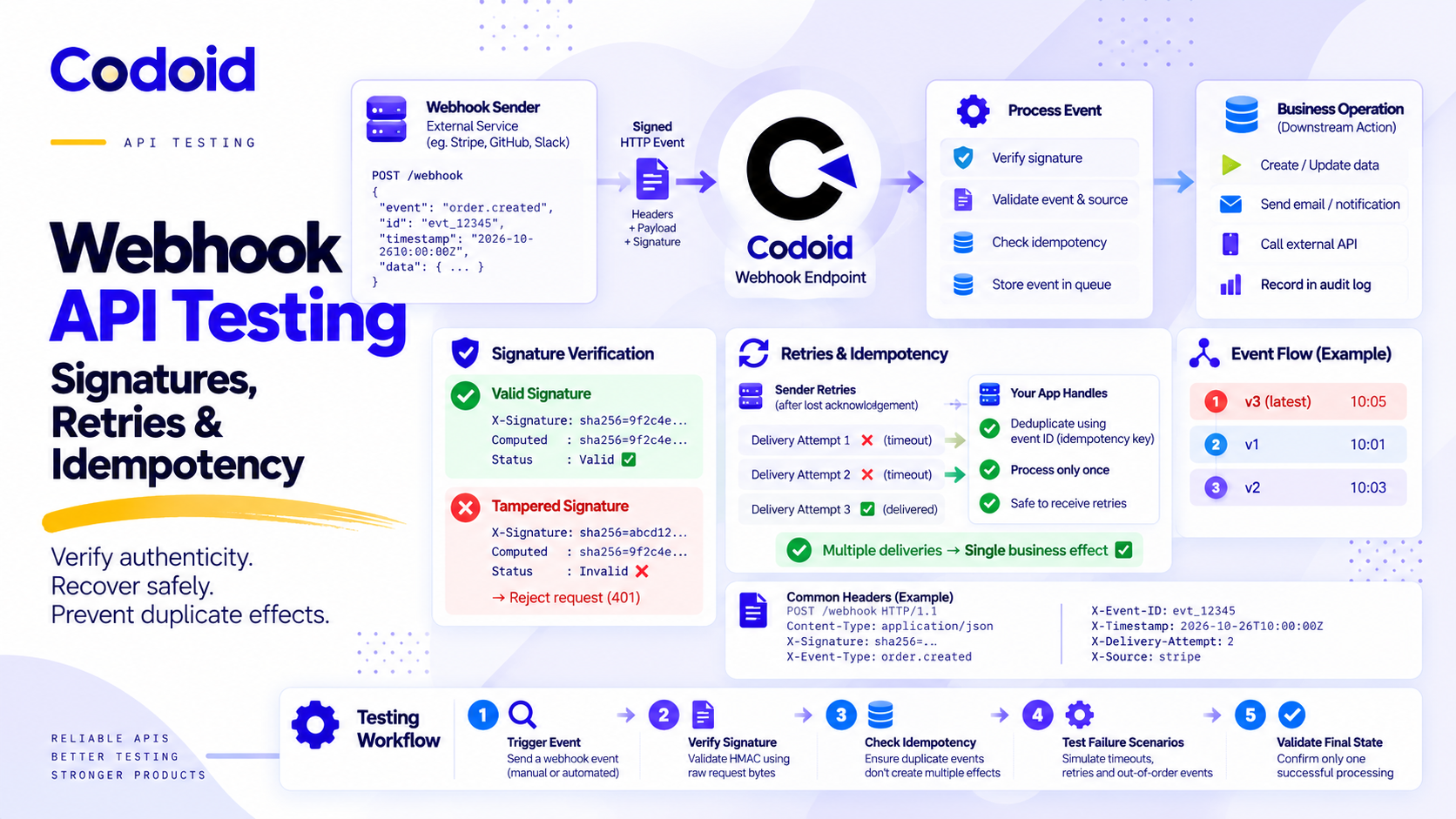
Webhook API testing verifies that an HTTP event is authentic, is accepted durably, can recover from failures, and produces the correct business result even after duplicate or out-of-order delivery. A successful HTTP status alone is not proof that the work completed. Test the request, inbox, worker, operation ledger, and final downstream effect together. This guide uses Stripe snapshot webhooks for the main signing example, compares GitHub and Shopify delivery contracts, and includes locally executable, clearly labelled illustrative tests. Business IDs, tenant mapping, and numbered resource versions in the examples are synthetic; they are not client results or provider-guaranteed fields.
Related Blogs
API Idempotency Testing: Safe Retries, Duplicates, and Payment Replays
API Negative Testing: Authentication, Authorization, Boundaries & Error Contracts
Table of Content
- How to Test a Webhook End to End: Quick Start
- What Should Webhook API Testing Validate?
- Define the Provider’s Delivery Contract First
- Build a Controlled Webhook Test Harness
- How to Test Webhook Signature Verification
- How to Test Webhook Retries and Recovery
- How to Test Duplicate Events and Idempotency
- How to Test Out-of-Order Webhook Delivery
- Automate the Regression Suite and Define Release Gates
- Conclusion
How to Test a Webhook End to End: Quick Start
Seven-Step Webhook Testing Workflow
A compact first pass can be completed before building a large fault-injection suite:
- Trigger an isolated provider-sandbox event or create a signed local fixture.
- Capture the raw request bytes, signature header, event identifier, sender account, and test-run correlation ID.
- Verify and authorize the signature, intended event type, source account, and resource-to-tenant mapping before accepting work.
- Commit recoverable work to an inbox or durable queue before responding with the documented success status.
- Inject one failure, such as a dropped acknowledgment, crashed worker, or dependency timeout; safely redeliver or retry according to the contract.
- Assert the business outcome, including the final database transition and exact permitted number of downstream actions.
- Review evidence connecting delivery attempts, worker state, idempotency keys, and the terminal outcome.
The path is verify, authorize, commit, acknowledge, process, assert. For a fast smoke test, use a successful event, an altered signature, and a duplicate. Expand to concurrent arrivals and crash recovery once the baseline is observable.
Example: Stripe CLI to a Local Webhook Receiver
Preconditions: Install the Stripe CLI, authenticate to an isolated Stripe test account, start a local POST /webhook receiver on port 4242, configure it for snapshot events, and connect it to a test-safe inbox and downstream stub. The route must read the raw body before JSON-parsing middleware changes it. Do not use a production payment account or a live external side effect.
Run in separate terminals:
# Terminal A: authenticate and forward snapshot events
stripe login
stripe listen --forward-to localhost:4242/webhook

# Terminal B: produce an illustrative test event
stripe trigger payment_intent.succeeded
Copy the whsec… signing secret printed by stripe listen into the local receiver’s secret configuration; the CLI listener secret differs from a separately registered Dashboard endpoint’s secret. Some CLI triggers create several related events, so filter by the subscribed event type and correlate the intended event ID rather than counting all incoming requests. See Stripe’s local listener and trigger instructions.
Expected outcome: the intended delivery receives a documented 2xx after durable acceptance; the inbox records the event once; the worker reaches completed; the test stub records exactly one permitted business action. Evidence: CLI output, receiver status, the inbox/worker transition, and a final operation-ledger or stub assertion. This procedure is provider-assisted, not proof that the application’s retry behavior has been tested until failures are deliberately injected.
What Should Webhook API Testing Validate?
Separate Delivery Acceptance from Business Completion
A webhook is an HTTP message from an external sender that can trigger asynchronous processing. Webhook testing checks its transport, authenticity, acceptance, processing, and resulting business state. A provider delivery retry repeats an HTTP request; an internal worker retry repeats already-accepted work. The latter may be required even when the sender recorded a successful response.
Apply these recommended receiver boundaries, adapting the exact response semantics to the provider:
- Verify the signed raw bytes with the correct endpoint secret.
- Validate and authorize the event type, sender account, destination, and allowed local tenant/resource.
- Commit an inbox record or equivalent durable job with a meaningful receipt key.
- Acknowledge quickly with the documented success response; perform slow business operations in a recoverable worker.
Test the following risks and required observable results:
- Forgery or altered payload: Bad signature or changed raw byte (Required observable result: Reject before trusted inbox/worker writes)
- Lost acknowledgment: Connection closes after inbox commit (Required observable result: Redelivery sees accepted work and does not duplicate effects)
- Duplicate or concurrent work: Identical and distinct event IDs for one operation (Required observable result: One protected business transition and one permitted remote action)
- Reordered or missing events: Newer snapshot first; gap or no delivery (Required observable result: Correct final state, reconciliation, or visible escalation)
Stripe recommends prompt 2xx responses for received events; avoiding dual-write loss and protecting downstream effects requires additional application design. See the Stripe webhook documentation and AWS transactional outbox guidance.
Define the Provider’s Delivery Contract First
Retry behavior differs by provider. Use this comparison to choose meaningful timeouts and recovery cases; it is not a universal service-level agreement.
- Stripe snapshot: Signed material/identification: Stripe-Signature signs raw bytes and a delivery timestamp; snapshot event.id identifies the event | Relevant delivery behavior: Live-mode automatic retries for up to three days; sandbox retries three times over several hours; no guaranteed event order
- GitHub: Signed material/identification: X-Hub-Signature-256 is a hex HMAC-SHA256; X-GitHub-Delivery tracks a delivery | Relevant delivery behavior: Expect a 2xx within 10 seconds; no automatic redelivery of failed deliveries; use manual/programmed recovery
- Shopify HTTPS: Signed material/identification: X-Shopify-Hmac-Sha256 is a Base64 HMAC; X-Shopify-Webhook-Id identifies deliveries and X-Shopify-Event-Id can correlate a merchant action | Relevant delivery behavior: 1-second connection and 5-second total timeout; eight retry attempts over four hours after failure
For Shopify Admin API subscriptions, repeated failed delivery can also result in subscription removal; include delivery-monitoring and re-subscription ownership in the runbook. For GitHub, use its delivery logs and supported redelivery mechanism rather than expecting automatic exponential retries. Confirm the relevant event format and account scope before applying any identifier or deadline rule. See GitHub best practices and Shopify verification.
Build a Controlled Webhook Test Harness
Prepare Isolated Fixtures, Secrets, and Observable Business Effects
Use a dedicated test secret, synthetic resource identifiers, isolated account/tenant mappings, and a downstream fake that records attempts, confirmed results, and idempotency keys. Give each test run a correlation ID. Keep the signature decision and failure category in logs without leaking secrets, raw sensitive payloads, or complete authorization headers.
The harness should control: signed payload bytes, request timing, simultaneous delivery barriers, acknowledgment failures, worker start/stop, durable inbox writes, downstream timeouts, and the authoritative state queried during reconciliation. In a real environment, test cleanup must not erase unrelated staging data.
(Figure 1 description: Instrument failures at commit boundaries. Flow goes HTTP delivery -> Verify + authorize -> Durable inbox -> Worker + retry -> Business ledger. F1: before durable acceptance; F2: acknowledgment lost after commit; F3: worker crash after claiming; F4: external effect completed but confirmation not recorded.)
Test One Complete HTTP-to-Business Path
Preconditions: The following small local simulator uses Node.js 22 built-ins (node:http, node:crypto, and node:test). It intentionally models a Stripe-style t=…,v1=… signature, a mock inbox, an asynchronous fake worker, a tenant-account allowlist, and an operation ledger. It is not the Stripe SDK, a real durable database, or the production receiver. It is useful for learning which route-to-outcome assertions to transfer into the real integration suite.
Save as webhook-route-smoke.test.cjs and run node --test webhook-route-smoke.test.cjs:
// Node 22, built-in modules only. LOCAL SIMULATOR, not the Stripe SDK.
const test = require('node:test');
const assert = require('node:assert/strict');
const { createHmac, timingSafeEqual } = require('node:crypto');
const { createServer } = require('node:http');

const SECRET = 'whsec_local_simulator_only';
const inbox = new Set(); // Mock: not crash durable
const operations = new Set(); // Mock: not a database ledger
const actions = []; // Mock: not a database ledger

const now = () => Math.floor(Date.now() / 1000);

function sign(body, timestamp = now()) {
  const mac = createHmac('sha256', SECRET)
    .update(Buffer.concat([Buffer.from(`${timestamp}.`), body]))
    .digest('hex');
  return `t=${timestamp},v1=${mac}`;
}

function trusted(body, header = '') {
  const items = Object.fromEntries(header.split(',').map(x => x.split('=')));
  const ts = Number(items.t);
  if (!Number.isSafeInteger(ts) || ts > now() - 300 || ts < now() - 30) return false;
  if (!/^[0-9a-f]{64}$/i.test(items.v1 || '')) return false;
  const sent = Buffer.from(items.v1, 'hex');
  const expected = Buffer.from(sign(body, ts).split('v1=')[1], 'hex');
  return sent.length === expected.length && timingSafeEqual(sent, expected);
}

const server = createServer(async (req, res) => {
  if (req.method !== 'POST' || req.url !== '/webhook') {
    res.writeHead(404).end(); return;
  }
  const chunks = [];
  for await (const chunk of req) chunks.push(chunk);
  const raw = Buffer.concat(chunks);

  if (!trusted(raw, req.headers['stripe-signature'])) {
    res.writeHead(400).end(); return;
  }

  let event;
  try { event = JSON.parse(raw.toString('utf8')); }
  catch { res.writeHead(400).end(); return; }

  // Illustrative provider-account-to-tenant mapping. No trust in body alone.
  if (event.account != 'acct_allowed' || event.type != 'payment_intent.succeeded') {
    res.writeHead(403).end(); return;
  }

  if (!inbox.has(event.id)) {
    inbox.add(event.id); // Simulates a committed inbox; in memory only.
    setImmediate(() => { // Simulates an asynchronous worker.
      const key = `${event.account}:${event.data.object.id}:activate`;
      if (!operations.has(key)) { operations.add(key); actions.push(key); }
    });
  }
  res.writeHead(200).end();
});

function payload(id, objectId = 'pi_same', account = 'acct_allowed') {
  return Buffer.from(JSON.stringify({
    id, type: 'payment_intent.succeeded', account,
    data: { object: { id: objectId, object: 'payment_intent' } }
  }));
}

async function post(body, header = sign(body)) {
  const response = await fetch(`http://127.0.0.1:${server.address().port}/webhook`, {
    method: 'POST', headers: { 'Stripe-Signature': header }, body
  });
  return response.status;
}

const settle = () => new Promise(resolve => setTimeout(resolve, 40));

test('signed route, rejection, duplicate and tenant mock assertions', async () => {
  await new Promise(resolve => server.listen(0, '127.0.0.1', resolve));
  try {
    const first = payload('evt_1');
    assert.equal(await post(first), 200);
    await settle();
    assert.equal(inbox.size, 1);
    assert.equal(actions.length, 1);
    assert.equal(await post(first), 200); // repeated event ID
    assert.equal(await post(payload('evt_2')), 200); // new ID; same business key
    await settle();
    assert.equal(actions.length, 1);
    assert.equal(inbox.size, 2);
    const altered = Buffer.from(first.toString().replace('pi_same', 'pi_other'));
    assert.equal(await post(altered, sign(first)), 400);
    assert.equal(await post(payload('evt_3', 'pi_other', 'acct_forbidden')), 403);
    assert.equal(inbox.size, 2);
    assert.equal(actions.length, 1);
    assert.equal(await post(first, sign(first, now() + 3600)), 400);
  } finally { await new Promise(resolve => server.close(resolve)); }
});
What this local test proves: A valid signed raw body reaches the simulated inbox; changed bytes cannot create trusted work; an unauthorized signed account is rejected; repeat delivery and two different event IDs sharing the same payment object produce only one synthetic business action; and an application-specific future-skew check rejects a far-future header. What it does not prove: crash durability, concurrent multi-process behavior, PostgreSQL transactions, correct Stripe SDK behavior, provider retry policy, or real external idempotency.
For the real receiver, replace the in-memory Sets with durable inbox and operation-ledger queries. Test a valid signing request with a committed inbox row, then rerun with a modified body and assert no inbox row, no worker job, and no downstream action. Deliberately place JSON parsing before raw-body verification in a controlled regression test: the test should fail if the original signed bytes are lost. Reject unknown local tenant mappings even when a signature is valid.
Capture Evidence Across the Complete Processing Path
Use a copiable evidence contract rather than a status-only assertion:
- Valid signed event and authorized account: Stimulus: POST to receiver | Assertions: Documented success response; inbox accepted; worker completed; one action | Evidence: HTTP trace, inbox key, worker ID, action ID
- Same body and altered signature: Stimulus: POST changed bytes with original signature | Assertions: Rejected before inbox and action creation | Evidence: Signature decision, zero trusted rows
- Two event IDs for same operation: Stimulus: Concurrent POSTs | Assertions: Two admissible receipts, one business transition | Evidence: Receipt IDs, ledger uniqueness, external effect key
- Existing accepted event, response lost: Stimulus: Retry same event | Assertions: No repeated business effect | Evidence: Attempts, one operation row
- Worker crash with leased job: Stimulus: Restart after configured lease | Assertions: Recovery or terminal alert; no silent loss | Evidence: Lease/attempt history, terminal state
- Event never arrives: Stimulus: Reconciliation compares source to local state | Assertions: Missing work repaired or escalated | Evidence: Authoritative snapshot, reconciliation ID
Use stable test IDs and bounded waits; a momentary zero count is not sufficient while work remains in flight.
Related Blogs
API Automation Testing with Postman, REST Assured, and Playwright: A Tester-Focused Guide
How to Test Webhook Signature Verification
Validate Raw Bytes, Signature Headers, and Endpoint Secrets
For Stripe snapshot events, call the SDK’s constructEvent() with the untouched body, signature header, and endpoint-specific whsec_ secret. For Stripe thin events, follow the separate parseEventNotification() flow. For GitHub and Shopify, match their distinct HMAC encodings and inputs; do not treat the Stripe timestamp format as universal. See Stripe event destination formats, GitHub signature verification, and Shopify verification.
Test the correct secret, a wrong secret, a missing/malformed header, altered JSON values, harmless-looking whitespace reserialization, UTF-8 content, unsupported HTTP method, unexpected event type, and an oversized body against your configured limit. For a custom HMAC verifier, decode into comparable byte arrays, reject unequal lengths, and use a timing-safe comparison such as Node’s crypto.timingSafeEqual(); the comparison alone does not make surrounding validation constant-time. An official maintained verification library is preferable to bespoke cryptography. See OWASP webhook security guidance.
Run a Pinned Stripe Node Signature Test
Prerequisites: Node.js 22 and [email protected]. Install with npm install --save-exact [email protected]; save the following as stripe-signature.test.cjs; run node --test stripe-signature.test.cjs. The local sk_test… string only constructs the SDK client; there are no live Stripe API calls in this fixture. The test uses the SDK’s generateTestHeaderString() and constructEvent() from the tagged v23.0.0 implementation. See the Stripe Node v23.0.0 source.
// Node.js 22; requires [email protected] (dependency not bundled).
const test = require('node:test');
const assert = require('node:assert/strict');
const stripe = require('stripe')('sk_test_local_only');

const secret = 'whsec_local_fixture_only';
const payload = JSON.stringify({
  id: 'evt_example',
  object: 'event',
  type: 'payment_intent.succeeded',
  data: { object: { id: 'pi_55', object: 'payment_intent' }}
});
const raw = Buffer.from(payload, 'utf8');
const headerAt = timestamp => stripe.webhooks.generateTestHeaderString({ payload, secret, timestamp });

test('snapshot HMAC and timestamp behavior', () => {
  // assertions follow here in the full fixture
});
Expected assertions: the exact signed body verifies; tampering and a wrong secret fail; and an hour-future signed header demonstrates library behavior, not desirable application policy. This snippet tests only the SDK helper. It does not test middleware order, the network endpoint, durable acknowledgment, or worker effects. Its implementation was syntax-checked for this revision; execution with the pinned package remains subject to dependency availability and the technical owner’s sign-off.
Test Replay Protection, Clock Boundaries, Tenant Authorization, and Secret Rotation
Stripe’s library has a default five-minute age tolerance. Inspection of the tagged Node v23.0.0 code shows timestampAge > tolerance, not a symmetric future-clock-skew rejection. A correctly signed request one hour in the future can therefore pass the library check. Define a separate application policy such as a configurable maximum_future_skew_seconds; test just inside and outside it, and do not accidentally disable Stripe’s age check with tolerance 0. A legitimately redelivered older business event can still have a newly signed delivery timestamp. See the Stripe Node v23 implementation and Stripe replay guidance.
A valid signature proves authenticity under the configured signing secret; it does not automatically authorize every local tenant, order, or resource. Test a validly signed event for provider account A whose referenced object is mapped to local tenant B. Expected: reject or quarantine before executing a tenant B operation; record a safe authorization decision. Test endpoint secret rotation within the documented overlap window, then rejection after the old secret is retired. Cover malformed or missing account context and prevent payload-supplied tenant labels from overriding trusted account-to-tenant mappings.
How to Test Webhook Retries and Recovery
Inject Failures Before and After Durable Acceptance
Sender redelivery repeats HTTP delivery; worker retry repeats accepted work. These paths can overlap, but they require different assertions.
- Reject invalid signature, wrong tenant, or malformed body: HTTP and processing expectation: Contract-specific 4xx; no trusted work | Evidence: Rejection reason, zero inbox/effects
- Inbox unavailable before commit: HTTP and processing expectation: Non-success or connection failure; safe sender recovery where supported | Evidence: No false accepted record; recovered attempt
- Lose response after inbox commit: HTTP and processing expectation: Retry may repeat delivery; inbox remains single-receipt | Evidence: One inbox key, duplicate HTTP attempts, one effect
- Worker fails after a recorded 2xx: HTTP and processing expectation: Internal worker retry or actionable failure, not necessarily provider retry | Evidence: Attempts, state changes, alerts
- Same downstream acknowledgment is lost: HTTP and processing expectation: Remote action succeeds, idempotency key or reconciliation; no second operation | Evidence: Remote confirmation, action ledger
- Deliberate 429, 500, or slow endpoint: HTTP and processing expectation: Sender-specific behavior; do not presume respect for Retry-After | Evidence: Provider delivery logs and response trace
For timing tests, select slow-request delays relative to the actual sender: GitHub’s ten-second response deadline and Shopify’s five-second total timeout must not be replaced by a universal test timeout. With Stripe, observe its sandbox delivery logs and resends rather than asserting an invented retry interval. See GitHub webhook practices, Shopify request limits, and Stripe delivery retries.
Separate Provider Redelivery from Internal Worker Retries
Configure processing deadline, maximum internal attempts, retry backoff, lease duration, and dead-letter alert rule in the application under test. These values depend on operational requirements and should be named in the test configuration, not presented as industry constants.
Illustrative policy assertions: given processing_deadline_seconds = D, a pending item older than D triggers an alert; given max_worker_attempts = M, the (M + 1)th attempt is not silently scheduled; and given a worker whose lease has expired, only an authorized recovery worker reclaims it. Require an alert that contains the event correlation ID and a safe failure reason. A retry that simply remains processing indefinitely must fail the release gate.
Test manual redelivery colliding with an existing worker retry and a post-commit lost acknowledgment. GitHub explicitly requires a manual/programmed redelivery route for failed events, while Stripe’s manual resend does not cancel its scheduled automatic attempts. See GitHub failed deliveries and Stripe manual retry behavior.
How to Test Duplicate Events and Idempotency
Distinguish Event Identity from Business-Operation Identity
Receipt identity: has this particular event been accepted by this subscribed consumer? Operation identity: has the protected business transition already occurred? The two keys are not interchangeable. Stripe notes that duplicate deliveries can repeat one event ID and that different events can also describe the same underlying object change. Shopify distinguishes delivery identity and the merchant-action event ID. See Stripe duplicate handling.
For example, two authentic events evt_A and evt_B can both request the operation tenant_demo:pi_55:activate. The test must permit traceable receipt of both events but assert one activation transition and one external action. The business key must be chosen for the actual business rule; using a resource ID alone can incorrectly discard later legitimate state changes.
Test Concurrent Duplicates, Worker Claims, Crashes, and Retention Boundaries
Receipt deduplication only: illustrative PostgreSQL 18 schema and insert:
CREATE TABLE webhook_inbox (
  provider text NOT NULL,
  tenant_id text NOT NULL,
  consumer text NOT NULL,
  event_id text NOT NULL,
  status text NOT NULL DEFAULT 'pending',
  attempts integer NOT NULL DEFAULT 0,
  lease_until timestamp2,
  received_at timestamp2 NOT NULL DEFAULT now(),
  PRIMARY KEY (provider, tenant_id, consumer, event_id)
);

INSERT INTO webhook_inbox (provider, tenant_id, consumer, event_id)
VALUES ('stripe', 'tenant_demo', 'billing', 'evt_A')
ON CONFLICT (provider, tenant_id, consumer, event_id) DO NOTHING
RETURNING event_id;
A row returned by RETURNING means this insert accepted a new receipt. No returned row means the key already exists, not that processing has completed. Apply a worker-claim transaction such as SELECT … FOR UPDATE SKIP LOCKED followed by a state update and lease, then commit; reclaim expired leases under a defined policy. When applying a local business operation, use a separate unique operation key and commit its transition and outbox record in the same transaction. An external call needs a stable remote idempotency key or reconciliation because neither inbox uniqueness nor local transactions alone guarantee exactly-once remote effects. See PostgreSQL INSERT … ON CONFLICT and PostgreSQL locking clauses.
Illustrative worker transaction outline (pseudocode; not executable SQL):
BEGIN TRANSACTION
  CLAIM one pending/expired-lease inbox row atomically
  INSERT business_operation(tenant, operation_key) if absent
  IF the operation row is new:
    APPLY the authorized local state transition
    ENQUEUE the downstream action in a transactional outbox
  MARK the inbox row completed or record retryable failure
COMMIT TRANSACTION
AFTER COMMIT: outbox dispatcher sends with stable idempotency key
Given: one pending entitlement, two receiver instances, and two worker instances. When: send five duplicate deliveries at a barrier, then separately send two different event IDs with the same business key; repeat after a worker crash. Then: inbox rows follow the receipt-key contract, the business operation exists once, and a remote idempotent action is confirmed once. Evidence: SQL rows, worker-claim/lease history, outbox entry, and downstream action receipt. Repeat just before and after the inbox’s retention expiry. Expiring a receipt record must not permit a harmful duplicate business transition.
How to Test Out-of-Order Webhook Delivery
Exercise Reversed Sequences, Missing Predecessors, and Concurrent Updates
For a synthetic internal snapshot contract with monotonically increasing resource_version, inject (v3, stock=7), then (v1, stock=9), then (v2, stock=8). Given local version 0 and a rule that a higher version supersedes a lower full snapshot, the expected final state is version 3 / stock 7, regardless of arrival order. Assert state and version atomically; send the same versions through two workers. This version field is not a guaranteed Stripe, GitHub, or Shopify event property.
For an incremental-delta contract, the rule is different: a missing predecessor can make a later delta invalid or incomplete. If the contract declares contiguous integer sequence numbers, detecting last_contiguous = 1 followed by incoming sequence 3 should create a visible gap for sequence 2. The receiver must buffer, reconcile, or escalate according to its documented contract, and close the gap only after verified recovery. Do not turn a provider event timestamp into a fake sequence number.
Choose State-Transition Checks, Documented Versions, or Reconciliation
- Event model: Complete snapshot with documented monotonic version | Recommended decision: Apply only a newer version atomically | Negative/failure assertion: v3 to v1 to v2 retains v3
- Event model: Notification referencing authoritative current state | Recommended decision: Fetch current source state with appropriate account authorization | Negative/failure assertion: Stale delivery does not overwrite current state
- Event model: Incremental delta with causal requirements | Recommended decision: Track necessary predecessors and repair gaps | Negative/failure assertion: Missing delta is not silently discarded
- Event model: Independent facts | Recommended decision: Process separately if business contract permits | Negative/failure assertion: One event’s retry does not suppress another fact
No-event-delivered test: Change the provider-side synthetic resource without delivering the notification to the receiver; run a scheduled reconciliation job with a recorded watermark and permitted credentials. It should detect a local/source mismatch, repair the current projection or produce an actionable unresolved record, and retain the reconciliation ID and evidence. If authoritative reads fail or are rate-limited, do not silently mark reconciliation complete. Stripe explicitly warns that events may arrive out of order and recommends fetching missing resources when needed. See Stripe ordering guidance.
Related Blogs
AI API Testing: Test Generation to Smarter Automation | Codoid
API Performance Testing: Response Time, Throughput, and Scalability
Automate the Regression Suite and Define Release Gates
Split Local, Integration, and Provider-Sandbox Coverage
Use local tests for deterministic signature fixtures, clock limits, business-key derivation, and state rules. Use integration tests for real persistence, multiple workers, lease recovery, failure injection, and downstream idempotency. Use provider-sandbox tests for actual sender signatures, endpoint subscriptions, delivery logs, source-account context, and retry or redelivery behavior. A signed local fixture does not prove a provider will retry a given status or deliver a particular shape.
CI rollout: run fast cases on every change; run fault tests against disposable resources on an appropriate schedule; run provider-sandbox contracts when credentials and isolation are available. Optional resilience tests should exercise delivery bursts, full queues, saturation, timeouts, and sender-aware 429 behavior without making unsupported throughput claims. Correlate sender logs with receiver and worker evidence. See Codoid’s REST API testing checklist for general negative API assertions and its payment API testing guide for payment-specific workflows.
Assert Eventual Completion and Retain Diagnostic Evidence
Do not declare a duplicate-safe test passed immediately after a request returns. The release assertion should proceed in order:
- Wait for a terminal state (completed, an approved equivalent, or an actionable failure) within the application’s declared processing deadline.
- Drain or account for scheduled work: no runnable retries, unexpired leases, or queued remote effects can later change the result unnoticed.
- Verify both ledgers and the remote result: compare receipt keys, business-operation keys, the final resource state, and the downstream action count/idempotency key.
- Gate: Authenticity / tenant isolation | Pass condition: Invalid or unpermitted requests produce zero trusted effects | Failure evidence: HMAC/authorization decision and zero inbox/actions
- Gate: Durable acceptance | Pass condition: 2xx implies recoverable accepted work under the chosen architecture | Failure evidence: Inbox commit and response trace
- Gate: Crash / retry recovery | Pass condition: Attempts reach completion or a visible failed-work terminal state by the configured deadline | Failure evidence: Worker history, alert, idempotency key
- Gate: Concurrent idempotency | Pass condition: Duplicate receipts do not create duplicate protected operations | Failure evidence: Ledger uniqueness and remote receipt
- Gate: Ordering / reconciliation | Pass condition: Final state follows the event contract; missed events are repaired or surfaced | Failure evidence: Version/gap state and reconciliation result
- Gate: Observability | Pass condition: Correlation IDs trace attempt to final effect without leaking secrets | Failure evidence: Sanitized logs and metrics
Record case IDs, code revision, runtime, SDK/database versions, provider endpoint configuration, and execution status as release evidence. A test that cannot access the configured provider, database, or downstream system is not a passed integration test.
Conclusion: Verify the Business Outcome, Not Just Delivery
A release-ready webhook integration authenticates and authorizes requests, commits recoverable work, limits repeated business effects, and reconciles delayed or missing events. Design tests around the exact points where acknowledgment, processing, and external effects can diverge. The decisive evidence is the final permitted business outcome, not a single successful HTTP response. Need independent validation of webhook signatures, retry recovery, and duplicate-safe processing? Explore Codoid’s API and Backend Testing Services or learn more about our broader API testing services.

Struggling with Webhook Reliability?
Talk to an API ExpertFrequently Asked Questions
-
Does a Successful HTTP Response Prove Webhook Processing Completed?
No. In an asynchronous receiver, success usually means that delivery met the sender-facing acceptance contract. Confirm the persisted inbox and eventual worker/business outcome separately.
-
Should a Duplicate Webhook Return an Error?
A safely recognized authentic duplicate will often receive a successful acknowledgment to avoid repeated sender attempts. But an existing key with unfinished or failed work must remain recoverable; use the actual sender and receiver response contract.
-
Does a Valid Signature Prevent Replay Attacks?
No. A signature authenticates the signed material, while freshness and business deduplication require separate controls. Stripe signs a delivery timestamp, but the tagged Node v23 implementation does not symmetrically reject all future timestamps.
-
How Can Webhook Retries Be Tested Without Waiting for the Full Retry Window?
Replay the same signed bytes in a controlled local harness and inject worker failures to test idempotency quickly. Use a provider sandbox or delivery logs to establish actual sender retry behavior, which local simulation cannot prove.
-
How Do You Test a Webhook End to End?
Trigger an isolated event; verify its raw-byte signature and account mapping; observe durable acceptance; wait for worker completion; then assert the final business record and permitted downstream action count. Repeat with an invalid signature and a duplicate.
-
Does GitHub Automatically Retry Failed Webhook Deliveries?
No. GitHub records failures and documents manual or separately automated redelivery; it expects successful responses within ten seconds.
-
What Tools Can You Use to Test Webhooks Locally?
The Stripe CLI can forward and trigger supported Stripe test events. Node's built-in test runner and HTTP client can exercise deterministic local receiver tests. A request inspector or a local tunnel can help capture deliveries where permitted, but none replaces assertions against the inbox, worker, and business result.






























Comments(0)