



























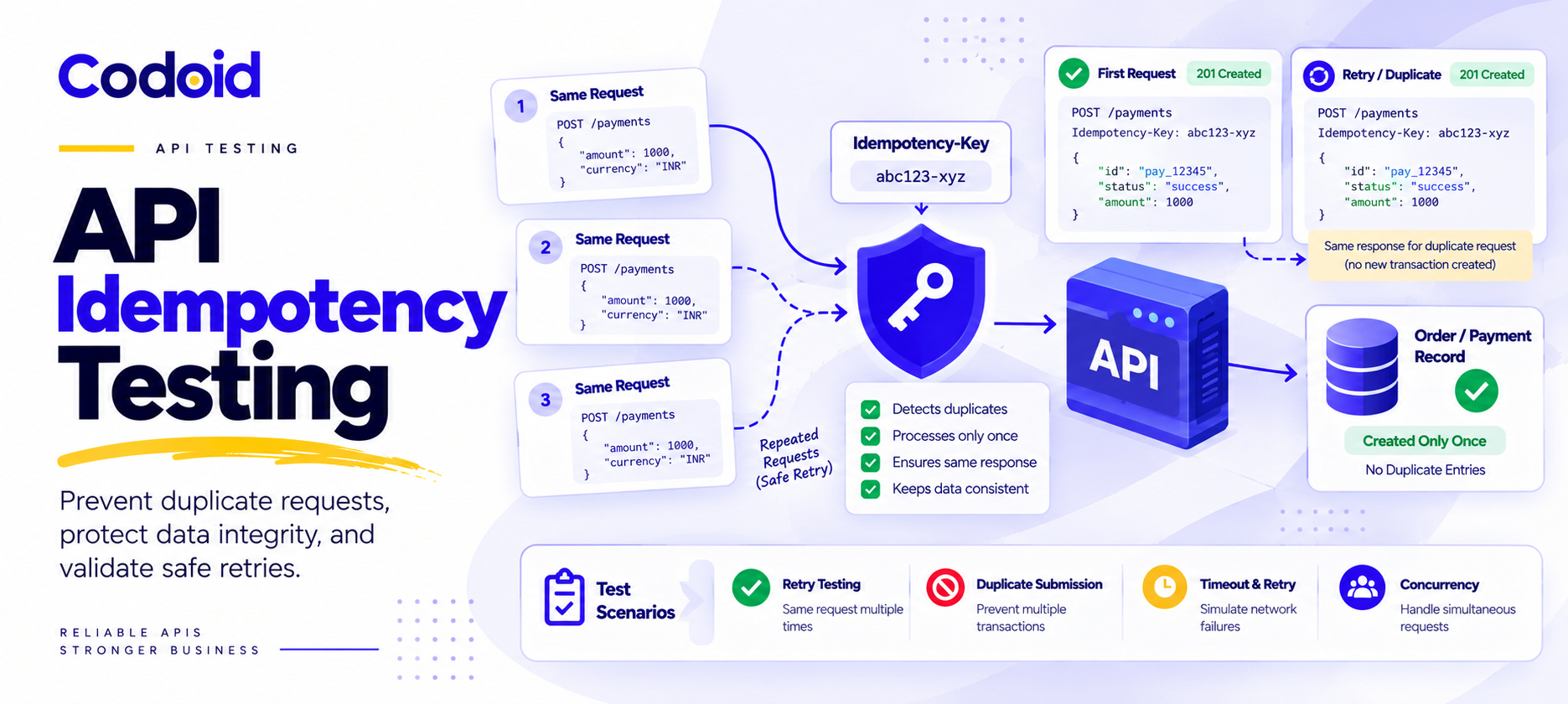
A customer submits a payment. The server processes it, but the response disappears before reaching the client. The application sees a timeout and retries. Did the customer pay once, or twice? The timeout alone cannot answer that question. It describes what the client observed, not necessarily what the server committed. Stripe’s error-handling documentation explicitly distinguishes network failures from known outcomes and recommends preserving the same idempotency key and parameters when retrying an uncertain request. API idempotency testing verifies that repeated attempts to perform one logical operation do not produce additional intended business effects. A useful test suite must examine more than repeated HTTP responses. It must verify persistent state, downstream payment activity, recovery behavior, and competing requests.
The central question is not simply, “Did both requests return the same payment ID?”
It is: after every retry, crash, and concurrent attempt has been resolved, did the system perform only the business operation that was intended? Codoid’s API and backend testing services apply this exact discipline when validating payment and workflow endpoints.
Table of Content
- 1. Define the Guarantee You Are Testing
- 2. Write the Idempotency Contract Before Writing Assertions
- 3. Build an Independent Business-State Oracle
- 4. Test Safe Retries at the Actual Failure Boundaries
- 5. Automate Duplicate and Concurrent Requests
- 6. Expand Beyond the Same-Key Happy Path
- 7. Distinguish Duplicate Requests From Concurrency Conflicts
- 8. Follow Payment Replays Across Every Service Boundary
- 9. Verify Retention, Isolation, and Recovery Behavior
- 10. Make the Suite Expose Implementation Defects
- Conclusion
1. Define the Guarantee You Are Testing
HTTP defines idempotency in terms of the intended server-side effect of repeated identical requests. Safe methods, along with PUT and DELETE, are idempotent by definition. A POST operation needs an endpoint-specific contract to provide retry protection. Idempotency also does not require every response to be identical or prohibit per-attempt logging.
For a payment-capture endpoint, translate that definition into explicit invariants.
    For one logical capture, within the documented scope and retention window:

    successful_capture_count <= 1
    gross_captured_amount <= requested_capture_amount
For a test scenario configured to succeed after temporary faults are removed, add a recovery requirement:
    Eventually, within the test's recovery budget:

    successful_capture_count == 1
    gross_captured_amount == requested_capture_amount
Both requirements matter. A server that rejects every request can satisfy “at most one capture” while failing to complete any legitimate payment.
This distinction separates safety, meaning nothing happens twice, from recovery, meaning accepted work does not remain unresolved forever.
It also avoids an unrealistic assertion about network traffic. Several HTTP attempts may be necessary. The test should count committed business effects, not demand exactly one network delivery.
2. Write the Idempotency Contract Before Writing Assertions
An idempotency key is meaningful only within a defined contract. For an API you control, document at least the following decisions.
| S. No | Contract area | What the test suite must know |
|---|---|---|
| 1 | Key scope | Is the key scoped to a tenant, account, endpoint, operation type, or another namespace? |
| 2 | Request identity | Which body fields, path parameters, query parameters, and operation-affecting headers must match? |
| 3 | Completed replay | Does the API return the original response, a current resource representation, or an operation-status resource? |
| 4 | In-progress duplicate | Does the server wait, return a documented conflict, or return an asynchronous operation reference? |
| 5 | Failure handling | Which failures reserve a key, which results are retained, and which outcomes remain uncertain? |
| 6 | Retention | How long is the guarantee valid, and what happens after logical expiration or physical deletion? |
| 7 | Authorization | What authorization checks apply when retrieving a previously recorded result? |
A useful design model separates lookup from request identity:
    lookup_identity = (authenticated_tenant, operation_namespace, idempotency_key)

    request_fingerprint = semantic_identity_of_the_operation
Keep those concepts separate. The lookup identity finds an existing operation. The fingerprint determines whether the new request actually represents that operation.
For a payment, fingerprint candidates include the amount, currency, destination, payment method, and business reference. A fresh tracing identifier should not normally turn a retry into a different business request. Conversely, changing the amount must not silently retrieve an unrelated success.
Provider Behavior Is Not Interchangeable
Stripe retains the first execution’s status and body, including 500 responses. It checks reused keys against the original parameters. Requests rejected before endpoint execution, including certain validation and concurrency failures, do not receive the same result-retention treatment.
PayPal documents a different replay model: PayPal-Request-Id can retrieve the latest status of the previous request. Support and retention depend on the API, and a simultaneous request with the same identifier may fail while the first is processed.
Adyen documents 409 or 422 responses with error code 704 for certain duplicates that arrive before completion. Its transient-error response header provides retry guidance.
Consequently, a test that accepts any “reasonable” response code is too permissive. Assert the documented status, machine-readable error code, and permitted follow-up behavior. A broader treatment of these checks appears in the payment API testing guide and the REST API testing checklist.
3. Build an Independent Business-State Oracle
A repeated success response is evidence about the response contract. It is not sufficient evidence about payment safety.
For each test operation, collect observations from authoritative systems rather than from the same replay cache being tested. Useful observations include the payment records, successful provider captures, gross captured amount, ledger posting groups, and fulfillment or receipt effects.
For an isolated payment of 2,500 minor units, an example terminal assertion is:
    payment_ids = [the_expected_payment_id]
    successful_captures = 1
    gross_captured_minor = 2500
    capture_posting_groups = 1
    fulfillment_effects = 1  # When required by the business contract
Count the logical ledger posting group, not an arbitrary number of ledger rows. Likewise, count gross captures rather than only the final net balance. Two charges followed by a compensating refund should still fail a duplicate-charge test.
Event-driven systems require another distinction. Multiple deliveries of a message do not necessarily mean multiple business effects. AWS’s transactional-outbox guidance explicitly warns that duplicate messages remain possible and recommends idempotent consumers.
Your oracle should therefore distinguish:
    message_delivery_count        # May exceed one

    committed_business_effects    # Must remain within the contract
Do not end an asynchronous test at the first successful observation. Drain the scheduled work, wait for a defined completion barrier, or observe through the relevant retry horizon before declaring that no duplicate effect occurred.
4. Test Safe Retries at the Actual Failure Boundaries
“Make the request time out” is not a sufficiently precise test specification.
The same client-visible timeout can occur before execution, during execution, or after the business effect has committed. Treat those as different scenarios.
| S. No | Injected failure point | Required verification |
|---|---|---|
| 1 | Before the request reaches business execution | A permitted retry can complete without losing the operation. |
| 2 | After claiming the key, before executing the operation | Recovery does not leave the key permanently in progress or allow two owners to execute. |
| 3 | After the provider accepts a payment, before local state is saved | Recovery identifies the existing provider operation rather than creating another charge. |
| 4 | After local completion, before the client receives the response | The same-key retry resolves to the completed operation without another effect. |
| 5 | After a downstream effect, before message acknowledgment | Redelivery does not repeat the downstream business effect. |
The Critical Payment Test: Commit, Lose the Response, Retry
Arrange a successful test payment and a unique key. Allow the payment to commit, then deliberately drop the response on its way back to the client. Retry with the original key and original operation parameters.
The passing result is not merely another successful response. Verify the same logical payment, one successful capture, the correct gross captured amount, and no additional ledger or fulfillment effect.
Use a controlled fault point or proxy rule that confirms the relevant commit occurred before discarding the response. An extremely short client timeout does not prove that the server reached the intended failure boundary.
Do Not Classify Every 500 as a Failed Payment
Stripe advises treating certain 500 outcomes as indeterminate because side effects may have occurred. It also warns against switching to a fresh key merely to escape the error: the original operation may already have changed state.
Test the recovery workflow separately from the replay response. Depending on the API, that workflow may involve an operation-status lookup, a provider-resource lookup, or later reconciliation.
Test the Retrying Client, Not Just the Receiving Server
Verify that the client preserves the logical key and request parameters across attempts, including process restarts where required. Give each HTTP attempt a separate tracing identifier without changing the operation identity.
Test retry eligibility, maximum attempts, overall deadlines, and server-provided retry guidance. Use capped backoff with jitter for eligible transient failures. AWS’s analysis of retry behavior shows why adding jitter spreads retry traffic rather than keeping clients synchronized.
Do not apply a blanket “retry every conflict” rule. For example, Adyen distinguishes retryable transient responses through its documented header behavior.
5. Automate Duplicate and Concurrent Requests
The following example uses Python, pytest, and HTTPX. HTTPX documents that its synchronous Client can be shared between threads. Python’s Barrier provides a way to release a group of waiting threads together.
This is an integration-test example for an illustrative API contract, not a direct Stripe, PayPal, or Adyen test.
Assume POST /payments returns 201 with a completed payment. Completed replays return the original status and JSON body. A changed payload returns 422 with idempotency_payload_mismatch. An overlapping duplicate returns 409 with idempotency_in_progress.
The example also assumes a private test-only endpoint, /__test/payment-audit, that reads authoritative business records. Its settled flag must mean the harness has drained the operation’s scheduled work, not merely observed one success. This endpoint is custom test infrastructure and must not be publicly exposed.
Set API_BASE_URL, API_TOKEN, and TEST_PAYMENT_METHOD for an isolated test deployment, then install pytest and httpx.
    # test_idempotency.py

    import os
    import time
    from concurrent.futures import ThreadPoolExecutor
    from threading import Barrier
    from typing import Any, Iterator
    from uuid import uuid4

    import httpx
    import pytest

    @pytest.fixture
    def api() -> Iterator[httpx.Client]:
        with httpx.Client(
            base_url=os.environ["API_BASE_URL"],
            headers={
                "Authorization": f"Bearer {os.environ['API_TOKEN']}"
            },
            timeout=httpx.Timeout(10.0, connect=3.0),
            limits=httpx.Limits(
                max_connections=16,
                max_keepalive_connections=16,
            ),
        ) as client:
            yield client

    def new_case() -> tuple[str, dict[str, Any]]:
        return str(uuid4()), {
            "reference": f"idem-test-{uuid4()}",
            "amount_minor": 2500,
            "currency": "USD",
            "payment_method": os.environ["TEST_PAYMENT_METHOD"],
        }

    def submit(
        api: httpx.Client,
        key: str,
        payload: dict[str, Any],
    ) -> httpx.Response:
        return api.post(
            "/payments",
            json=payload,
            headers={
                "Idempotency-Key": key,
                "X-Request-ID": str(uuid4()),  # Unique per HTTP attempt.
            },
        )

    def assert_one_capture(
        api: httpx.Client,
        reference: str,
        payment_id: str,
        amount_minor: int,
    ) -> None:
        deadline = time.monotonic() + 15.0
        observed: dict[str, Any] = {}

        while time.monotonic() < deadline:
            response = api.get(
                "/__test/payment-audit",
                params={"reference": reference},
            )
            response.raise_for_status()
            observed = response.json()

            # Fail immediately on an observed duplicate.
            assert observed["successful_captures"] <= 1, observed

            if observed["settled"]:
                assert observed["payment_ids"] == [payment_id], observed
                assert observed["successful_captures"] == 1, observed
                assert (
                    observed["gross_captured_minor"] == amount_minor
                ), observed
                assert observed["capture_posting_groups"] == 1, observed
                return

            time.sleep(0.1)

        pytest.fail(f"Operation did not settle: {observed}")

    def test_sequential_replay_and_payload_mismatch(
        api: httpx.Client,
    ) -> None:
        key, payload = new_case()
        first = submit(api, key, payload)
        assert first.status_code == 201, first.text
        original = first.json()
        assert original["status"] == "succeeded", original

        for _ in range(5):
            replay = submit(api, key, payload)
            assert replay.status_code == 201, replay.text
            assert replay.json() == original

        changed = {**payload, "amount_minor": 3000}
        conflict = submit(api, key, changed)
        assert conflict.status_code == 422, conflict.text
        assert (
            conflict.json()["error"]["code"]
            == "idempotency_payload_mismatch"
        )

        # A mismatch must not overwrite or poison the original result.
        replay = submit(api, key, payload)
        assert replay.status_code == 201, replay.text
        assert replay.json() == original

        assert_one_capture(
            api, payload["reference"], original["id"],
            payload["amount_minor"],
        )

    def test_concurrent_same_key(api: httpx.Client) -> None:
        key, payload = new_case()
        workers = 16
        start = Barrier(workers, timeout=5.0)

        def attempt(_: int) -> httpx.Response:
            start.wait()
            return submit(api, key, payload)

        with ThreadPoolExecutor(max_workers=workers) as pool:
            responses = list(pool.map(attempt, range(workers)))

        successes: list[httpx.Response] = []
        for response in responses:
            if response.status_code == 201:
                successes.append(response)
            else:
                assert response.status_code == 409, response.text
                assert (
                    response.json()["error"]["code"]
                    == "idempotency_in_progress"
                )

        assert successes, "No attempt completed successfully."

        original = successes[0].json()
        assert original["status"] == "succeeded", original
        assert all(r.json() == original for r in successes)

        final_replay = submit(api, key, payload)
        assert final_replay.status_code == 201, final_replay.text
        assert final_replay.json() == original

        assert_one_capture(
            api, payload["reference"], original["id"],
            payload["amount_minor"],
        )
Run the example with:
pytest -q test_idempotency.py
Several details are intentional.
First, the concurrent test permits multiple successful HTTP responses. Those can be valid replays of one execution. Requiring exactly one 201 would incorrectly reject the stated contract.
Second, the test rejects unexpected errors rather than accepting a broad collection of status codes.
Third, the audit assertion is independent of response equality. For an API that returns current state instead of a stored response, replace full-body equality with the documented identity and state assertions.
Finally, the client barrier encourages overlap but does not prove that requests overlapped inside the server. Add a deterministic server-side test gate after the first request claims the key. Hold that request, send duplicates, verify the in-progress behavior, and then release the owner.
6. Expand Beyond the Same-Key Happy Path
The example covers the essential mechanics. A production API idempotency testing suite needs additional dimensions.
Same Key, Different Operation Parameters
Change the amount, currency, destination, payment method, business reference, or target resource independently. Verify that the server does not execute the altered operation or overwrite the original fingerprint.
Repeat this test while the first request is still running. The immediate response may follow the documented in-progress policy, but the altered operation must never be executed under the original key.
Equivalent Serialization
Where the API promises semantic JSON comparison, reorder object properties and vary insignificant whitespace. Conversely, test distinctions such as omitted versus null fields, array order, and numeric representations according to the schema.
Do not silently normalize away meaningful differences merely to make tests pass.
Different Keys
Submit genuinely independent operations using different keys and verify that neither is incorrectly suppressed.
Also test the same business intent under different keys. This is a separate requirement: a rule such as “only one full payment for this order” must be enforced through business identity, not assumed to follow from client-generated retry keys.
Include a negative control where identical payloads are legitimately allowed to represent separate operations. Otherwise, payload-based deduplication or a business uniqueness constraint may hide a broken idempotency-key implementation.
Invalid and Missing Keys
Exercise missing, empty, oversized, and malformed values, along with ambiguous duplicate header fields. Verify the documented rejection or optional-key behavior and confirm that rejected requests create no payment effects.
Keep validation-failure tests distinct from post-execution failure tests. A single blanket assertion about whether all errors consume a key will miss that boundary.
7. Distinguish Duplicate Requests From Concurrency Conflicts
Same-key requests ask the system to recognize one operation repeatedly.
Different-key requests may represent competing operations that must not both succeed.
For example, two separately identified refunds could each be individually valid while their combined amount exceeds the refundable balance. Idempotency protection for each refund does not, by itself, enforce the shared balance constraint.
Test that business invariant directly.
For versioned resources, HTTP conditional requests provide another conflict-control mechanism. If-Match uses strong entity-tag comparison to prevent stale writes. A failed precondition normally produces 412 Precondition Failed, subject to the documented already-applied-operation exception.
A useful test schedule is:
    Client A reads resource version "v7".
    Client B reads resource version "v7".

    A submits update A, key A, If-Match: "v7".
    B submits update B, key B, If-Match: "v7".
Verify that only an allowed version transition commits.
Verify that the stale update does not overwrite it.
Then replay the winning operation using its original key and original precondition. Confirm the documented replay behavior without a second mutation.
Keep these outcomes distinct in assertions and telemetry: an idempotency mismatch, an operation still in progress, and a stale resource version are different conditions even when an API happens to use overlapping status codes.
8. Follow Payment Replays Across Every Service Boundary
Protecting the public endpoint is only the beginning.
For a payment workflow, test the complete path:
    Client
        ↓
    Payment API
        ↓
    Payment provider
        ↓
    Local ledger
        ↓
    Event publication
        ↓
    Fulfillment or receipt processing
Preserve Downstream Operation Identity
For your design, persist a logical payment-operation identifier before making the provider call. Associate the downstream idempotency key with that operation and action.
A capture and a refund need distinct identities. Two intentionally separate partial captures also need distinct identities. Retries of the same capture must reuse its identity.
The critical recovery schedule is: the provider accepts the operation, the application crashes before recording success, and a replacement worker resumes processing. Verify that recovery reuses or locates the existing provider operation instead of creating a new one. PayPal documents precisely this kind of capture-timeout recovery using the original request identifier.
Do not require exactly one provider HTTP call in this fault scenario. Require at most one committed provider effect.
Test Webhook Duplication Independently
Stripe documents duplicate event deliveries and does not guarantee event ordering. It recommends tracking processed event identifiers and notes that some duplicate notifications can arrive as separate event objects.
Test repeated delivery, concurrent delivery, out-of-order delivery, and distinct notifications that represent the same documented business transition. Verify that ledger posting and fulfillment remain correct.
Also inject a crash between the business mutation and recording that the event was processed. The test should expose designs that can either repeat the effect or mark work complete before it actually happens.
Keep Security Replay Checks Separate
A legitimate redelivery is not the same as replaying an old captured signature. Stripe signs delivery timestamps and generates a new timestamp and signature for each retry.
Test valid redelivery, invalid signatures, and expired signing timestamps separately. A previously seen event identifier must not become a shortcut around authentication.
9. Verify Retention, Isolation, and Recovery Behavior
Retention Boundaries
Stripe permits pruning keys once they are at least 24 hours old and treats reuse after pruning as a new request. That is a bounded guarantee, not permanent business deduplication.
For your own idempotency store, use a controllable clock to test just before expiration, at the boundary, after logical expiration, and after physical cleanup.
Verify what happens to operations still in progress when their retention or ownership timers expire. Do not let a cleanup test pass merely because the record disappeared. Establish whether a retry can now duplicate unfinished work.
Test the combined local and provider retention contract as well. A longer local retention period does not extend the provider’s documented guarantee.
Tenant and Authorization Isolation
Reuse the same literal key under different tenants and operation namespaces. Depending on the contract, those requests may be independent or rejected, but they must not expose another caller’s result.
Repeat a request after credential rotation and after access revocation. For your API, explicitly require appropriate authorization before returning a stored result. OWASP’s object-level authorization guidance applies whenever an endpoint returns data associated with an identified object.
Restarts, Failover, and Expired Ownership
Restart workers between attempts. Route duplicates to different application instances. Exercise store outages, failover, and recovery after an ownership lease expires.
A particularly useful schedule pauses an old worker, allows recovery to transfer ownership, and then resumes the old worker. Verify that stale ownership cannot authorize conflicting writes or additional payment effects.
Test regional behavior against the actual scope guarantee. Adyen, for example, explicitly states that duplicate-key checks do not extend across simultaneously targeted regional endpoints.
For payment systems, make “do not silently remove retry protection when the store fails” an explicit resilience requirement.
10. Make the Suite Expose Implementation Defects
A classic race-prone implementation is conceptually:
    Check whether key exists.
    Perform the payment.
    Save the key and result.
Two requests can both pass the initial check. A test that exercises only sequential retries will not expose that schedule.
Where the relevant state is local, test an atomic claim backed by an appropriate uniqueness constraint or conditional write. PostgreSQL’s ON CONFLICT mechanisms provide database-level conflict handling, but the surrounding workflow still needs correct transaction boundaries.
AWS’s idempotent-API guidance emphasizes atomicity between recording the request token and the related mutations. External provider calls require additional recovery coordination because they are outside that local transaction.
For event publication, a transactional outbox can couple the local business update with the event record. It does not remove the need to test duplicate delivery and idempotent consumption.
Organize execution around complementary layers:
- Contract tests for replay responses, mismatches, key validation, and scope.
- Deterministic integration tests for overlapping requests, commit-boundary failures, worker crashes, and downstream redelivery.
- Stress and recovery tests for varied fan-out, hot keys, many independent keys, failover, and retention transitions.
Record enough evidence to reconstruct each run: logical operation ID, per-attempt request ID, scoped key hash, claim owner, provider operation ID, state transitions, and recovery actions. Avoid logging payment credentials or sensitive payloads.
Finally, deliberately break the implementation. Disable the atomic claim, generate a new downstream key during retries, or remove a consumer’s deduplication check. The corresponding tests should fail for the expected reason.
That is a stronger confidence signal than a green suite that has never demonstrated sensitivity to the defect it claims to prevent.
Conclusion
API idempotency testing is not a two-request status-code comparison. It is a test of business invariants under repeated delivery, partial failure, and competing execution. A trustworthy suite verifies the documented replay contract, independently counts committed effects, exercises ambiguous payment outcomes, distinguishes duplicates from resource conflicts, and follows recovery through downstream consumers.
Build the contract before writing assertions. Use an independent oracle that reads authoritative systems rather than the replay cache. Test the actual failure boundaries, including commit, lost response, and retry. Then deliberately break the implementation and confirm that the suite catches the defect. Codoid’s QA automation services help teams build idempotency test suites that surface duplicate-charge and lost-payment defects before they reach production.

Need Help Building Your API Idempotency Testing Strategy?
Talk to an API Testing ExpertFrequently Asked Questions
-
What is API idempotency testing?
API idempotency testing verifies that repeated attempts to perform one logical operation do not produce additional intended business effects. It examines persistent state, downstream payment activity, recovery behavior, and competing requests, not just repeated HTTP responses.
-
What is the difference between idempotency and safety in API testing?
Safety means nothing happens twice. Recovery means accepted work does not remain unresolved forever. Both matter. A server that rejects every request can satisfy "at most one capture" while failing to complete any legitimate payment.
-
Why is checking the HTTP status code not enough for idempotency testing?
A repeated success response is evidence about the response contract, not about payment safety. The real check is whether the underlying business effects occurred once. Count successful captures, gross captured amount, ledger posting groups, and fulfillment effects from authoritative systems, not from the replay cache being tested.
-
How should idempotency keys be scoped?
An idempotency key is meaningful only within a defined contract. Document key scope, request identity fields, completed replay behavior, in-progress duplicate behavior, failure handling, retention window, and authorization checks before writing assertions.
-
Do different payment providers handle idempotency the same way?
No. Stripe retains the first execution's status and body, including 500 responses, and checks reused keys against the original parameters. PayPal uses PayPal-Request-Id to retrieve the latest status of the previous request. Adyen documents 409 or 422 responses with error code 704 for duplicates that arrive before completion. Assert the documented status, machine-readable error code, and permitted follow-up behavior for each provider.
-
Should every 500 response be treated as a failed payment?
No. Certain 500 outcomes are indeterminate because side effects may have occurred. Do not switch to a fresh idempotency key merely to escape the error, because the original operation may already have changed state. Test the recovery workflow separately from the replay response.
-
How do you test concurrent requests with the same idempotency key?
Use a client-side barrier to release multiple threads together, and permit multiple successful responses when they are valid replays of one execution. Add a deterministic server-side test gate after the first request claims the key to prove that requests overlapped inside the server. Then verify that the audit confirms at most one committed business effect.
-
What is the difference between a duplicate request and a concurrency conflict?
Same-key requests ask the system to recognize one operation repeatedly. Different-key requests may represent competing operations that must not both succeed. Idempotency protection for each refund does not enforce a shared refundable-balance constraint. Test business invariants separately.
































Comments(0)