



























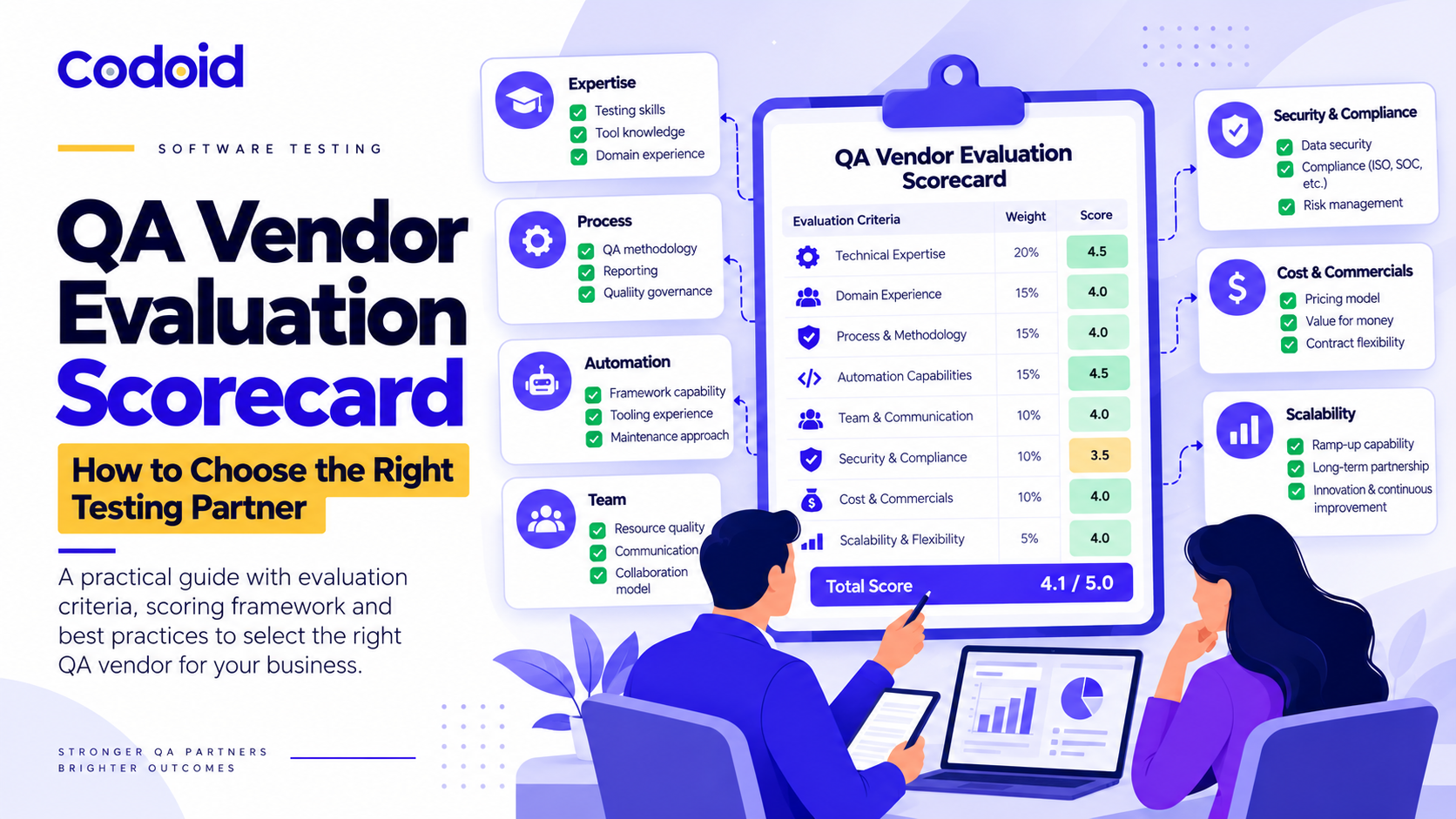
Imagine comparing three software testing proposals. One promises extensive automation. Another highlights industry experience. A third offers the lowest hourly rate. Which company is the best choice? The proposals alone cannot answer that question. You need to establish what each vendor can demonstrate, whether its approach addresses your product’s risks, and what the engagement will actually cost. A QA vendor evaluation scorecard turns that assessment into a structured decision. It combines weighted criteria, consistent evidence requirements, and mandatory pass or fail checks across five dimensions: expertise, coverage, governance, security, and return on investment.
The objective is not to find the vendor with the longest service catalog. It is to identify the partner best equipped to support your quality goals, and to make the reasons for that decision clear. Codoid’s software testing services follow this evaluation logic when scoping new engagements.
Related Blogs
QA Automation Company Hiring: Look Beyond Tool Expertise | Codoid
Microservices Testing: A Practical Strategy for QA and Development Teams
Table of Content
- Start With Your Requirements, Not the Vendor’s Presentation
- Separate Mandatory Requirements from Weighted Preferences
- The QA Vendor Evaluation Scorecard
- Score the Evidence, Not the Promise
- 1. Expertise: Evaluate the Team That Will Do the Work
- 2. Coverage: Measure Important Risks, Not Test Inventory
- 3. Governance: Establish Ownership, Transparency, and Escalation
- 4. Security: Inspect Working Practices and Assurance Scope
- 5. ROI: Compare the Complete Economics
- Validate Finalists Through a Common Pilot
- Example: Comparing Three Software Testing Companies
- Turn the Evaluation into Delivery Commitments
Start With Your Requirements, Not the Vendor’s Presentation
Before evaluating software testing companies, give every candidate the same brief.
Describe your application architecture, critical user journeys, supported platforms, release cadence, existing test assets, and major quality problems. Explain what success should look like: shorter regression cycles, better visibility into release risk, stronger accessibility assessment, or fewer serious production defects.
Also define the engagement model. Are you buying additional testers, a specialist assessment, or a managed testing service? Do not compare a staff-augmentation quote with a fully managed proposal without normalizing their responsibilities and costs.
For security-related requirements, the NIST Secure Software Development Framework provides a useful foundation. It supports procurement conversations while emphasizing that practices should be tailored to business requirements, risk tolerance, and resources, not treated as a universal checklist.
Separate Mandatory Requirements from Weighted Preferences
Some requirements should determine eligibility rather than merely contribute points.
The UK National Cyber Security Centre recommends setting proportionate minimum security requirements, incorporating them into supplier contracts, and requiring relevant obligations to flow down to subcontractors.
For your evaluation, establish three groups of gates:
- Security and data handling: The vendor can meet your required access controls, data restrictions, confidentiality terms, and incident-reporting arrangements.
- Delivery feasibility: The proposed team has the mandatory capabilities, availability, and working-hour overlap needed for the engagement.
- Contract and ownership: The vendor accepts essential terms covering deliverables, intellectual property, permitted use of its tools, and transition assistance.
Mark each gate as Pass, Fail, or Pending. A failed or unresolved mandatory requirement should block final approval, regardless of the weighted score.
Establish these rules before reviewing bids. Otherwise, a persuasive presentation can quietly redefine what your organization considers essential.
The QA Vendor Evaluation Scorecard
The following is a proposed starting framework, not an industry benchmark or a certification scheme. Adjust the weights to your product’s risk profile before issuing the request for proposal. The subweights make it possible to score specific capabilities rather than assign one impression-based rating to an entire category.
| S. No | Evaluation dimension | Total weight | Suggested subcriteria and weights | Evidence to request |
|---|---|---|---|---|
| 1 | Expertise | 25% | Domain relevance: 8; technical and test-engineering depth: 9; proposed delivery team: 8 | Comparable engagements, technical walkthroughs, named-team interviews, references |
| 2 | Coverage | 25% | Critical workflows and failure scenarios: 10; integrations and platform coverage: 7; nonfunctional testing: 8 | Risk-based test strategy, traceability matrix, environment matrix, sample results |
| 3 | Governance | 20% | Responsibilities and service management: 8; reporting and escalation: 6; continuity and handover: 6 | Responsibility matrix, sample dashboard, escalation process, staffing and exit plans |
| 4 | Security | 20% | Access and test-data protection: 8; assurance evidence: 6; subcontractor, tool, and incident controls: 6 | Control demonstrations, scoped audit reports, data-flow documentation, incident procedures |
| 5 | ROI and commercial value | 10% | Complete and comparable cost model: 5; evidence-backed benefits: 5 | Itemized pricing, assumptions, baseline measures, benefit calculations, sensitivity analysis |
| 6 | Total | 100% |
Keep the boundaries clear. Coverage evaluates how the vendor will test your application’s security. Security evaluates how the vendor protects your organization while performing its work. These are different questions.
Likewise, evaluate automation engineering under expertise, but assess which product risks the resulting tests address under coverage. Avoid awarding the same capability points twice.
Score the Evidence, Not the Promise
Use a consistent scale for every subcriterion in your QA vendor evaluation scorecard.
| S. No | Score | Evidence standard |
|---|---|---|
| 1 | 0 | No usable response or acceptable evidence by the evaluation deadline |
| 2 | 1 | Capability asserted, but unsupported |
| 3 | 2 | Partially relevant evidence, with material gaps |
| 4 | 3 | Meets the requirement, supported by relevant evidence reviewed by your evaluators |
| 5 | 4 | Strong, repeatable capability verified through a demonstration, pilot, or comparable delivery evidence |
| 6 | 5 | Materially exceeds predefined, relevant targets, supported by convincing validation |
Define what a 3, 4, and 5 mean for important criteria before vendors respond. “Exceeds expectations” is too subjective unless those expectations are documented.
Calculate the result using:
Weighted score = Σ [(criterion score ÷ 5) × criterion weight]
Use weights as points totaling 100. A criterion worth eight points contributes 6.4 points when rated four out of five.
In the working scorecard, add columns for the evidence reference, evidence date, evaluator, score rationale, and unresolved questions. Missing evidence means the capability remains unverified. It does not necessarily mean the vendor lacks it.
Only mark a criterion “not applicable” because of the agreed scope, not because a vendor cannot satisfy it. Apply any weight redistribution consistently across all candidates.
1. Expertise: Evaluate the Team That Will Do the Work
For this scorecard, assess expertise at three levels: domain understanding, technical judgment, and the assigned team’s ability to deliver.
Test Domain Understanding With Realistic Scenarios
Instead of asking, “Have you worked in our industry?”, present a problem.
For a payment workflow, ask how the vendor would test duplicate submissions, retries after a timeout, partial failures, refunds, and reconciliation. For a subscription platform, ask about plan changes, billing boundaries, access entitlements, and cancellation.
Evaluate whether the response identifies business consequences, ambiguous requirements, and failure conditions, not just happy-path test cases.
Request comparable engagement examples that explain the initial problem, the vendor’s responsibilities, and the evidence behind the reported result. Ask references whether the proposed team members actually participated.
Examine Technical Judgment, Not Tool Familiarity Alone
Have the vendor walk through a small, relevant test implementation.
Ask why particular checks belong at the unit, API, integration, or user-interface level. Examine assertions, test-data setup, failure diagnostics, and maintenance decisions. For teams evaluating Playwright-based suites, the patterns in Codoid’s Playwright test architecture guide provide a useful reference for what mature test engineering looks like.
DORA’s test-automation guidance emphasizes fast, reliable automated suites integrated into delivery pipelines, alongside ongoing manual activities such as exploratory and usability testing. This provides a stronger evaluation basis than simply counting automation tools or scripts.
Ask the proposed engineers, not only a sales architect, to explain how they would investigate an intermittent failure.
Verify Staffing Commitments
Confirm who will lead the engagement, which specialists are shared, how replacements are approved, and what knowledge-transfer process applies when someone leaves.
Treat certifications as supporting information. Require demonstrated competence for the responsibilities that matter most.
High-value vendor question: Which proposed team members have solved a problem comparable to ours, and what work can they show us?
2. Coverage: Measure Important Risks, Not Test Inventory
Require a coverage plan that connects product risks to test activities and evidence.
For each critical workflow, ask the vendor to identify the relevant requirements, failure scenarios, test levels, configurations, data needs, execution frequency, and accountable owner.
Separate what is planned from what has been executed. Report passed, failed, blocked, and untested scenarios distinctly.
Look Beyond Functional Correctness
Build the required coverage around your application, not a generic checklist.
For example, an evaluation might include business-rule validation and exploratory testing, API contracts and third-party integration failures, browser, device, and operating-system combinations, and quality attributes such as performance, accessibility, security, and recovery. Codoid’s REST API testing checklist is a useful reference for what an API-level coverage plan should contain, and the accessibility testing services overview covers the equivalent scope for accessibility.
Ask vendors to identify exclusions explicitly. A focused specialist proposal can be acceptable when the remaining responsibilities are clearly assigned. An unexplained gap should not be.
For performance testing, require an agreed workload model, representative environment assumptions, and acceptance criteria. A result without those conditions is not sufficient evidence for your scorecard.
Challenge Misleading Coverage Claims
A claim such as “90% code coverage” needs context. Google’s testing guidance explains that code coverage indicates execution, not necessarily correct assertions or adequate examination of edge cases. It also rejects a universal ideal coverage percentage for every product.
Ask which high-impact behaviors remain untested and why. Assess whether the vendor can explain the residual risk instead of defending a headline percentage.
Specify the Security and Accessibility Assessment Scope
For application security, require an agreed verification scope rather than accepting a vague promise of “OWASP testing.” The OWASP Application Security Verification Standard provides technical verification requirements and recommends including version information when referencing requirement identifiers. Codoid’s OWASP Mobile Security Testing Checklist shows what this looks like when applied to mobile platforms.
For accessibility, specify the applicable WCAG version, conformance level, user journeys, and evaluation methods. W3C states that tools alone cannot determine whether a site meets accessibility standards. Knowledgeable human evaluation is required.
Use those distinctions when assessing proposals. An automated accessibility scan and a broader accessibility evaluation should not receive identical scores.
High-value vendor question: What important risks will remain outside your proposed coverage, and how will you make them visible before release?
3. Governance: Establish Ownership, Transparency, and Escalation
Use the governance score to assess how the engagement will operate when requirements change, environments fail, or a release decision becomes contentious.
Make Responsibilities Explicit
Require a responsibility matrix covering test planning, environment readiness, test-data preparation, execution, defect triage, fixes, retesting, and release recommendations.
Distinguish vendor-controlled obligations from shared outcomes. For example, the QA vendor may own defect reporting and retesting, while your developers own code changes.
Service-level agreements should reflect that distinction. A target for acknowledging a critical defect is different from a commitment to repair it.
Reserve final release approval and acceptance of residual risk for an explicitly authorized decision-maker.
Ask for Reporting That Supports Decisions
Request a sample dashboard and release-readiness report. Look for evidence that answers these questions:
- What was tested?
- What was not tested?
- Which critical scenarios failed or remain blocked?
- Which exceptions need a decision?
- What changed since the previous report?
For ongoing measurement, consider:
| S. No | Measure | Definition to agree before the engagement |
|---|---|---|
| 1 | Critical-scenario status | The approved scenario set, with planned, executed, passed, failed, and blocked results |
| 2 | Regression turnaround | Start and finish conditions, including how environment delays are treated |
| 3 | Automation reliability | Confirmed flaky or infrastructure-related failures, reporting method, and maintenance effort |
| 4 | Escaped defects | Severity, affected scope, release attribution, and observation window |
| 5 | Commercial performance | Actual spend, approved scope changes, and forecast cost to complete |
Use delivery outcomes as shared measures. DORA identifies change lead time, deployment frequency, failed deployment recovery time, change fail rate, and deployment rework rate. Its guidance emphasizes application-level context and shared ownership rather than using metrics to encourage competition or finger-pointing.
Do not attribute every improvement or deterioration in those measures to the QA vendor alone.
Plan for Continuity and Exit
Evaluate staffing backups, documentation practices, access to test assets, and the handover process. Require a demonstration that your team can run and maintain the delivered assets under the agreed licensing terms.
High-value vendor question: Show us how your reporting would support a release decision when some tests are blocked and a serious defect remains unresolved.
Related Blogs
PMS Sync Testing: A Practical QA Guide for Property Management System Integrations
SaaS Testing: The Launch Failures No One Tests For (Until It’s Too Late)
4. Security: Inspect Working Practices and Assurance Scope
For this scorecard, require evidence about the actual delivery arrangement: the people, systems, locations, tools, and data involved.
Assess Everyday Access and Data Handling
Ask the vendor to demonstrate how it provisions and removes access, applies least privilege, protects credentials, and controls work on managed devices.
Map where source code, test data, screenshots, logs, recordings, and defect attachments will be stored. Include collaboration tools and device-testing services, not just the primary test environment.
Prefer synthetic or appropriately de-identified data where practical. Document any approved exceptions, their safeguards, and who is authorized to accept the risk.
Have your security and legal teams determine the contractual and regulatory requirements applicable to your organization.
Read the Evidence Behind the Badge
ISO/IEC 27001 concerns requirements for an information security management system. It is relevant assurance evidence, but its subject is information security management, not the testing competence of an individual delivery team.
SOC 2 evidence also needs interpretation. A Type 2 examination includes evaluation of operating effectiveness over a specified period. A Type 1 examination does not assess performance over a historical period in the same way. Microsoft’s compliance documentation also illustrates the importance of reviewing exceptions and customer control responsibilities.
For the evaluation, inspect the relevant legal entity, service scope, locations, reporting period, auditor’s opinion, exceptions, remediation status, and responsibilities your organization must fulfill.
Do not award full points merely because a logo appears in a proposal.
Include Subcontractors and AI-Enabled Tools
Extend the assessment to any third party that could receive your information.
Require disclosure of approved AI tools and ask what code, logs, prompts, or test data they can receive, what retention and model-training terms apply, and who reviews generated work.
Also establish incident-reporting channels, escalation responsibilities, evidence preservation, and cooperation expectations. NCSC’s supply-chain guidance specifically recommends defining incident-reporting arrangements and information return or deletion requirements in supplier contracts.
High-value vendor question: Can you trace where our information goes throughout your testing workflow, including subcontractors and AI tools, and demonstrate the controls at each step?
5. ROI: Compare the Complete Economics
Evaluate commercial value against a defined baseline, scope, and time horizon.
A lower hourly rate does not establish a lower engagement cost. The comparison also depends on the staffing mix, effort required, included services, internal support, and ongoing maintenance.
Build a Normalized Total-Cost Model
For each candidate, account for:
    Total cost = vendor fees
               + transition costs
               + additional tools and infrastructure
               + internal oversight
               + ongoing maintenance
               + applicable exit costs
Do not add a cost twice when it is already included in the vendor’s fee.
Require pricing assumptions for working hours, specialist involvement, execution volumes, overtime, minimum commitments, scope changes, and renewal terms. Normalize currencies and the evaluation period.
For a fixed-price proposal, examine the boundaries and change-control mechanism. For time-and-materials work, examine effort forecasts, approval controls, and spending limits. For outcome-linked pricing, define how results will be measured and which dependencies sit outside the vendor’s control.
Separate Three Kinds of Benefit
Keep cash savings, productive capacity, and forecast risk reduction distinct.
Freed employee hours are not automatically cash savings. They become a monetary benefit only through an agreed mechanism, such as reduced external expenditure, an avoided hire, or additional productive output.
Similarly, an estimate of avoided incident losses is not guaranteed cash. Document the incident assumptions, expected impact, and portion of the improvement reasonably attributable to the engagement.
Do not count the same benefit twice. For example, do not value freed hours as labor savings and then also assign the full value of those hours to faster releases.
An Illustrative First-Year ROI Calculation
Suppose all introduced first-year program costs total $120,000. Compared with continuing the current approach, the business forecasts:
| S. No | Attributable first-year benefit | Illustrative value |
|---|---|---|
| 1 | Avoided baseline external regression-testing expenditure | $70,000 |
| 2 | Reduction in expected incident and remediation costs | $60,000 |
| 3 | Incremental contribution margin from earlier releases | $20,000 |
| 4 | Total forecast benefits | $150,000 |
Using a consistent incremental approach:
    ROI = [(attributable benefits - introduced program costs)
           ÷ introduced program costs] × 100

    ROI = [($150,000 - $120,000) ÷ $120,000] × 100 = 25%
These figures are fictional, not a market benchmark. This is a forecast economic return, not a promise of cash savings.
If benefits reach only $90,000, the same calculation produces a negative 25% ROI. That downside case belongs in the decision alongside the base case.
Apply the same accounting treatment to every vendor. When avoided baseline expenditure is counted as a benefit, do not also deduct it from program costs.
High-value vendor question: Which benefits can we validate, which remain assumptions, and does the business case remain acceptable under a downside scenario?
Validate Finalists Through a Common Pilot
Use a bounded pilot to test important claims before making the final selection.
Give finalists the same representative application scope, safe test data, environment conditions, time budget, and access to clarification. Require participation from the proposed delivery team.
Ask them to produce a risk assessment, relevant tests, reproducible defect reports, and a release-readiness recommendation.
Include a controlled application change during the exercise. Observe how each team updates tests, investigates failures, and explains the impact on coverage.
Assess useful findings and false positives together. Do not select a winner solely by counting reported bugs.
The pilot should also test handover. Have someone on your team run the delivered assets using the documentation and access rights provided.
Use pilot results to update the existing scorecard. Do not invent new scoring rules after seeing which vendor performs best.
Example: Comparing Three Software Testing Companies
The following fictional comparison uses the proposed category weights. Ratings represent the weighted averages of each category’s subcriteria.
| S. No | Dimension | Weight | Vendor A | Vendor B | Vendor C |
|---|---|---|---|---|---|
| 1 | Expertise | 25% | 4 | 4 | 5 |
| 2 | Coverage | 25% | 4 | 5 | 5 |
| 3 | Governance | 20% | 3 | 4 | 5 |
| 4 | Security | 20% | 3 | 4 | 2 |
| 5 | ROI and commercial value | 10% | 5 | 3 | 5 |
| 6 | Weighted score out of 100 | 100% | 74 | 83 | 88 |
| 7 | Mandatory requirements | Pass | Pass | Fail |
Vendor C has the highest numerical score but fails a mandatory requirement. It is not eligible for final approval unless the failure is resolved and verified.
Vendor B has the strongest weighted result among eligible candidates. Vendor A remains a potential alternative, but its commercial advantage must be considered alongside its lower governance and security ratings.
This is why eligibility and ranking must remain separate.
Before awarding the contract, examine whether reasonable scoring uncertainty could change the result. Resolve material evidence gaps rather than treating a small difference in points as scientific precision.
Turn the Evaluation into Delivery Commitments
The scorecard should not disappear once procurement ends.
Carry the winning proposal’s commitments into the statement of work: assigned roles, coverage obligations, deliverables, reporting, security controls, commercial assumptions, and handover requirements. Give unresolved actions an owner and a completion condition.
Revisit the assessment at agreed review points and when the scope, team, tools, or data access changes. The framework in Codoid’s QA automation services and API and backend testing services pages reflects how these commitments typically translate into ongoing delivery obligations.
The best QA partner is not necessarily the cheapest company, the largest company, or the company promising the most tests.
It is the company that can demonstrate the right expertise, address your important risks, work transparently, protect your information, and deliver value you can measure.

Need Help Evaluating QA Vendors for Your Organization?
Talk to a QA SpecialistFrequently Asked Questions
-
What is a QA vendor evaluation scorecard?
A QA vendor evaluation scorecard is a structured decision tool that combines weighted criteria, consistent evidence requirements, and mandatory pass or fail checks across five dimensions: expertise, coverage, governance, security, and return on investment. It replaces impression-based vendor selection with a documented, repeatable assessment.
-
How should mandatory requirements differ from weighted preferences?
Mandatory requirements should determine eligibility rather than contribute points. Group them into security and data handling, delivery feasibility, and contract and ownership. Mark each gate as Pass, Fail, or Pending. A failed or unresolved gate should block final approval regardless of the weighted score.
-
How do I score evidence instead of promises?
Use a consistent 0 to 5 scale where each level has a defined evidence standard. Zero means no usable response, one means unsupported assertion, three means the requirement is met with relevant evidence, and five means materially exceeding predefined targets with convincing validation. Define what a 3, 4, and 5 mean for important criteria before vendors respond.
-
What should the expertise dimension evaluate?
Assess expertise at three levels: domain understanding, technical judgment, and the assigned team's ability to deliver. Test domain understanding with realistic failure scenarios rather than industry claims. Examine technical judgment through a walkthrough of a small test implementation. Verify who will lead the engagement and how replacements are handled.
-
What should the coverage dimension include?
Build coverage around your application, not a generic checklist. Include business-rule validation, exploratory testing, API contracts, third-party integration failures, browser and device combinations, and quality attributes such as performance, accessibility, security, and recovery. Require vendors to identify exclusions explicitly.
-
Why does the scorecard separate coverage from security?
Coverage evaluates how the vendor will test your application's security. Security evaluates how the vendor protects your organization while performing its work. These are different questions. Automation engineering belongs under expertise, while the product risks those tests address belong under coverage.
-
How do I evaluate vendor security assurance evidence?
Read the evidence behind the badge. Inspect the relevant legal entity, service scope, locations, reporting period, auditor's opinion, exceptions, remediation status, and responsibilities your organization must fulfill. ISO/IEC 27001 addresses information security management, not individual team testing competence. SOC 2 Type 1 and Type 2 examinations provide different levels of assurance.
-
How should ROI be calculated in a QA vendor evaluation scorecard?
Use a normalized total-cost model that accounts for vendor fees, transition costs, additional tools and infrastructure, internal oversight, ongoing maintenance, and applicable exit costs. Separate cash savings from productive capacity and forecast risk reduction. Use a consistent incremental approach and include a downside scenario alongside the base case.
-
Should finalists complete a pilot before selection?
Yes. Use a bounded pilot with the same representative scope, safe test data, environment conditions, and time budget for every finalist. Require participation from the proposed delivery team. Include a controlled application change during the exercise and require a handover demonstration. Use pilot results to update the existing scorecard rather than inventing new scoring rules.




























Comments(0)