






















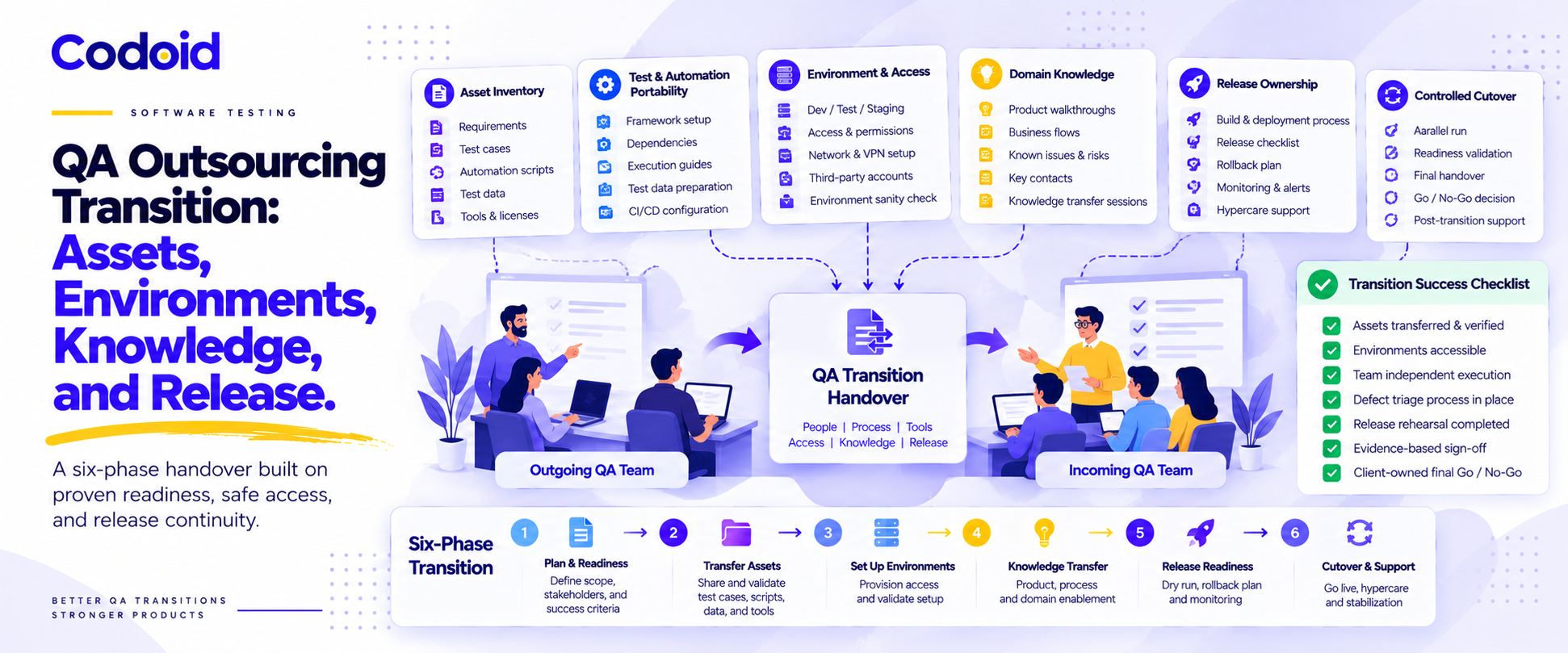
To transition QA to an outsourcing partner without creating release gaps, define the responsibility boundary, inventory and transfer the testing estate, and then verify the incoming team’s capability through independent execution, defect triage, environment recovery, and release rehearsals. Approve cutover only when the evidence meets agreed criteria and the client has a workable fallback. This guide is for QA and engineering leaders taking their first step into outsourced testing or replacing an existing QA supplier. Use the six phases in order, then copy the working checklist into your transition tracker. A test repository, a training attendance record, or a successful smoke test is not sufficient proof that the new team can operate independently. A disciplined QA outsourcing transition is a tested change to your operating model, not a file transfer.
At a glance: define accountable owners, baseline assets and risk, prove test and automation portability, provision environments and access safely, validate domain expertise, and rehearse QA readiness and release gates before removing outgoing-team access.
Related Blogs
QA Vendor Evaluation Scorecard: Compare Testing Companies on 5 Dimensions
QA Automation Company Hiring: Look Beyond Tool Expertise | Codoid
Table of Contents
- A QA Transition Succeeds Only When the Incoming Team Can Operate Independently
- Define the Ownership Boundary Before Transferring Anything
- Define Transition Acceptance Criteria
- Phase 1: Inventory the Existing QA Estate and Establish a Baseline
- Phase 2: Transfer Test Assets Without Losing History or Dependencies
- Phase 3: Transfer Environments, Integrations, and Access Safely
- Phase 4: Transfer Domain Knowledge Through Demonstration and Teach-Back
- Phase 5: Transfer Release Ownership One Gate at a Time
- Phase 6: Cut Over Through Controlled Parallel Operation
- Use Explicit Exit Criteria Before Declaring the Transition Complete
- QA Outsourcing Transition Checklist
- Common Transition Failures and How to Diagnose Them
- Conclusion
A QA Transition Succeeds Only When the Incoming Team Can Operate Independently
Transition completion means demonstrated capability, not delivery of files. The incoming team should be able to select risk-based coverage, prepare test data, execute and maintain tests, investigate failures, submit useful defects, report residual risk, and operate only those release gates expressly delegated to it. The client must still name the person authorized to accept business risk and issue the final go or no-go decision.
ISO 37500:2014 describes outsourcing as an arrangement with governance, risk management, and responsibilities that may differ by phase and by client-provider relationship. Its public abstract is general outsourcing guidance rather than a QA-specific certification requirement (Source: ISO 37500).
A useful supporting analogy is Google’s SRE onboarding model. Teams train through hands-on exercises, assume duties progressively, transfer access and change-management responsibilities, and retain temporary backup from the previous owners. That model is about production operations, not a prescriptive QA outsourcing standard, but it supports an evidence-led cutover.
For every transferred capability, capture the receiving owner, the test of independence, the evidence location, the evaluator, and the client approver. Treat a failed exercise as a tracked transition defect, not as an informal follow-up.
Define the Ownership Boundary Before Transferring Anything
Decide what the external QA team will perform, what internal engineering, DevOps, and security teams will retain, and which decisions cannot be delegated without explicit authority. Record the scope in a responsibility assignment matrix before accounts, repositories, or tickets change hands.
Build a Responsibility Matrix for QA Operations
In the example below, R means responsible for performing the activity. A means accountable for the decision or outcome. This is an illustrative allocation, not a universal contract model.
| S. No | Activity | Incoming QA partner | Client-side accountable owner | Evidence of ownership |
|---|---|---|---|---|
| 1 | Test strategy and prioritization | R: proposes risk-based plan | A: QA lead or product owner | Approved plan for next release |
| 2 | Manual and automated execution | R: performs tests and retains results | A: client QA lead for agreed scope | Independent runs and reviewed reports |
| 3 | Automation maintenance | R: fixes and extends agreed suites | A: designated repository owner | Reviewed change through CI |
| 4 | Test-data preparation | R: uses approved synthetic or authorized data | A: data owner or security | Logged preparation and cleanup drill |
| 5 | Environment diagnosis and recovery | R: first-line diagnosis within permission boundary | A: internal DevOps or platform owner if retained | Approved recovery exercise |
| 6 | Defect triage | R: reproduction and impact evidence | A: product or engineering for business priority | Representative triage record |
| 7 | QA release-readiness recommendation | R: supplies evidence and recommendation | A: client QA or release governance owner | Accepted readiness report |
| 8 | Final production go or no-go | C: provides risk advice, not automatically approver | A and R: named client business or engineering approver | Decision and exception record |
The contract and operating model may place additional responsibilities with the provider, but vendor QA approval must not silently become business release authorization. Also name backup approvers, an emergency escalation path, and the team that owns change control.
For a vendor replacement, verify the signed arrangements governing test-code and report ownership, intellectual-property rights, repository and account custody, licenses, confidentiality, exit assistance, permitted subcontractors, retention, and data return or deletion. Legal and privacy specialists should interpret these obligations. A blog checklist is not legal advice. The contract review is a conditional gate, not an assertion that every jurisdiction imposes identical terms.
Define Transition Acceptance Criteria
Make each phase pass an exit gate before its dependent responsibilities move. The client transition owner decides whether remaining gaps are tolerable, and the risk owner documents each exception.
| S. No | Phase | Minimum exit demonstration | Accountable evaluator |
|---|---|---|---|
| 1 | Baseline | Reconciled risk-ranked register, known gaps, and ownership | Client QA lead |
| 2 | Assets | Clean checkout, CI execution, triage, and maintenance change | QA automation lead |
| 3 | Environment and access | Approved task-based access, safe data use, recovery escalation | Security and platform owners |
| 4 | Domain | Critical journey teach-back and defect investigation | Product or domain owner |
| 5 | Release gates | QA recommendation and blocked-release rehearsal | Client release manager |
| 6 | Cutover | Incoming-led representative cycle and agreed fallback | Client transition sponsor |
These are example gate categories, not numerical thresholds. Define the required journeys, integrations, platforms, permissible exceptions, and number of rehearsals for the specific product. High-risk changes may need more than one representative cycle.
Phase 1: Inventory the Existing QA Estate and Establish a Baseline
Create a Test-Asset Register
Inventory active manual suites, exploratory charters, automation repositories and dependencies, shared utilities, test-data generators, API collections, CI jobs and runners, test environments, device and browser matrices, defect backlogs, reports, dashboards, traceability, and retained evidence. Mark obsolete suites for archive or retirement after checking whether they contain unique coverage. Do not migrate everything merely because it exists.
| S. No | Asset | Custodian or destination | Dependency and risk | Required transfer proof |
|---|---|---|---|---|
| 1 | Critical regression cases | Client test-management workspace | Shared steps, tags, requirement links | Count and relationship reconciliation |
| 2 | Automation repository | Client-controlled or contractually agreed Git host | Runtime, lockfile, runner, service licenses | Independent build, run, and maintenance PR |
| 3 | Test-data builder | Approved repository or data owner | Seed data, cleanup, sensitive fields | Reproducible creation and reset |
| 4 | Results and defect history | Client-controlled report or archive | Attachments, run IDs, and retention | Sample historic report retrievable |
| 5 | Web accessibility test assets, if in scope | Agreed test-management location | Applicable WCAG target, assistive technology, and browser matrix | Manual and automated evidence to agreed scope |
If accessibility testing is part of the mandate, specify the target, such as WCAG 2.2 Level AA where applicable and contractually chosen, together with assistive-technology and browser combinations. Automated scans alone cannot establish full conformance. W3C describes WCAG evaluation as involving automated checks and human evaluation (Source: W3C WCAG overview and W3C conformance explanation).
Inventory Environments and Dependencies
For each QA or staging environment, record its owning team, build and deployment paths, API endpoints and third-party sandboxes, feature flags, identity provider, database and queue dependencies, supported devices, certificates, secrets-management references, CI agents, logs, dashboard access, data refresh or reset procedures, shared usage windows, and incident escalation route. Record permissions needed for specific operations, not merely URLs.
Record the Current Operating Baseline
Before any transfer, capture required critical journeys, current coverage gaps, release blockers, flaky or quarantined tests, open defects, exceptions, data restrictions, and typical build and release cadence. If the organization uses metrics, agree a small dictionary instead of comparing raw vendor dashboard numbers.
| S. No | Metric | Definition and caution | Baseline owner or source |
|---|---|---|---|
| 1 | Required test execution coverage | Executed eligible planned tests divided by all eligible planned tests. Report blocked and not-run separately | QA lead or test management |
| 2 | Critical journey evidence | Named required journeys with accepted evidence divided by required journeys. Any omitted journey must be explicit | Product owner or coverage map |
| 3 | Automation instability | Identified nondeterministic failures over a stated time window. Separate app failures, reruns, and quarantines | Automation owner or CI |
| 4 | Defect triage turnaround | Time from valid report to first agreed triage decision. Compare like-for-like severity and time windows | Defect lead or issue tracker |
A pass-rate percentage alone can hide unexecuted high-risk tests. Always show its numerator, denominator, exclusions, blocked cases, and unresolved material defects. Do not imply that a universal percentage makes a release safe.
Phase 2: Transfer Test Assets Without Losing History or Dependencies
Move Manual Test Assets With Traceability Intact
Migrate the approved active cases together with suite hierarchy, shared steps, parameters, configuration, expected results, links, attachments, ownership, and appropriate historic evidence. Check counts and relationships, then sample critical workflows end to end. Archive retired or obsolete cases where agreed instead of treating archive size as coverage.
Transfer Automation as Maintainable Source Code
Handover must include the source repository and permissions, language and runtime versions, dependency manifests and lockfiles, CI configuration and runner ownership, service accounts, schedules, test-data fixtures, report publication, failure artifacts, licensing, supported browsers and devices, known flaky or quarantined cases, and procedures to create, run, debug, and modify tests. Check third-party provider-hosted runners and service tokens. A repository is not independent if the new team cannot execute it after the outgoing vendor leaves.
Codoid’s public guide on QA automation services also emphasizes framework maintainability, CI gating, and a genuine handover rather than a list of tools.
Reconcile What Migration Tooling Does Not Preserve
Do not infer migration completeness from a success message. Microsoft documents that Azure Test Plans copy and import operations can preserve test-suite hierarchy and configurations while not preserving test run history, results, or tester assignments. Preservation of shared parameters and links also depends on the operation. Check the actual capabilities of the tool and migration path used.
For each category, record source count, destination count, preserved relationships, deliberately excluded assets, separately archived evidence, sampling result, and unresolved mismatch. If historical runs cannot move, retain the required records in an approved and searchable archive with an owner and retention rule.
Prove Portability With an Independent-Operation Test
Use a receiving-team engineer who was not the outgoing suite’s primary author. The evaluation should cover both a successful run and a controlled failure.
Preconditions: named repository and CI roles are approved. A non-production environment is available. Permitted synthetic test data exists. Runner dependencies and reporting destination are documented.
Actions:
- Perform a clean checkout.
- Install locked dependencies.
- Configure through approved secrets references.
- Create or reset synthetic data.
- Run a risk-selected suite through CI.
- Diagnose a deliberately broken non-production assertion.
- Fix or explain the failure.
- Submit an automation change for normal review.
- Publish an evidence-linked report.
Pass criteria: no undocumented outgoing-vendor access. Expected critical tests execute or have a signed exception. A controlled failure is correctly detected and triaged. A maintenance change passes approved review. Log and report access works for the new owner. Failing one mandatory criterion means Fail, even if overall test counts look high.
| S. No | Field | Example entry |
|---|---|---|
| 1 | Scenario and owner | AT-02 and Incoming automation lead |
| 2 | Required behavior | Run checkout tests from client-controlled CI. Seed and clean test data. Diagnose a broken test and publish a report |
| 3 | Observed issue | Example: runner requires a token owned by the outgoing supplier |
| 4 | Expected result and evaluation | Fail until approved replacement identity works and the full exercise is rerun |
| 5 | Evidence | Placeholder: CI-RUN-EXAMPLE, PR-EXAMPLE, redacted triage log, not live links |
| 6 | Exception and risk owner | No bypass approved. Client DevOps owner assigned token migration |
| 7 | Evaluator and approver | Client QA automation lead and client transition sponsor |
| 8 | Sign-off timestamp and status | Not signed. Fail in this hypothetical record. Populate actual date and time only after witnessed retest |
This record illustrates why an apparently green smoke run must not override a hidden ownership dependency.
Phase 3: Transfer Environments, Integrations, and Access Safely
Document Environment Topology, Not Just URLs
Capture component versions, integration topology, deployment paths, allowed reset or rollback operations, data dependencies, alerting and logging, change windows, shared-user impact, and recovery contacts. A dangerous database reset or queue purge must not be carried out solely to prove a handover. First confirm non-production scope, permitted operator, change approval, backup and rollback prerequisites, and escalation to platform or DevOps owners.
Re-Provision Credentials Instead of Handing Around Secret Values
Provision named accounts and appropriately scoped service identities instead of transferring passwords. Use the organization’s approved identity provider, multifactor authentication, least privilege, session and audit logging, and time-bounded access reviews. NIST SP 800-53 Rev. 5 provides a customizable security and privacy controls catalog covering access control, identity and authentication, and audit. It is not a blanket statement that every QA supplier must implement every control.
| S. No | Access record field | Purpose |
|---|---|---|
| 1 | System | Identifies the target environment or service |
| 2 | Incoming identity | Named account or service principal |
| 3 | Business justification | Documents why access is required |
| 4 | Requested role or permission | Scoped privilege level |
| 5 | Data classification | Defines handling requirements |
| 6 | Authorizing owner | Named approver |
| 7 | Multifactor authentication requirement | Confirms MFA is enforced |
| 8 | Provisioned date | Start of access window |
| 9 | Review or expiry date | Forces periodic recertification |
| 10 | Logging or audit location | Where activity is recorded |
| 11 | Revocation owner | Who removes access |
| 12 | Verification evidence | Proof that access was tested |
Verify approved remote-work locations, devices, and subcontractor access where applicable.
Data and evidence safeguards: Prefer synthetic or minimized test data. When production-derived or pseudonymized data is necessary, obtain explicit data-owner and privacy approval, enforce applicable masking and transfer controls, and specify access purpose, location, retention, and destruction. Pseudonymized records may still be personal data under relevant laws. Where UK GDPR controller and processor requirements apply, the ICO describes mandatory contractual terms including authorized processing, security, subprocessors, and deletion or return at contract end. Do not generalize that legal regime to every QA engagement.
Defect attachments, logs, screenshots, and API traces should use approved storage and restricted access. Capture minimum necessary data, redact tokens, passwords, connection strings, and personal or regulated information, and establish retention and deletion rules. The OWASP Logging Cheat Sheet explicitly identifies these categories as data that should generally be excluded or protected in logs.
Validate Access Through Tasks
Have the incoming team demonstrate its authorized work. Clone code. View CI artifacts. Launch a permitted test job. Read an approved log. Seed data. Access agreed dashboards. Raise a defect. Operate a specifically delegated non-production gate. Security verifies that unapproved actions fail, including attempts to access production data or bypass a release approval. Record owner, reviewer, observed outcome, and expiry for each test.
Run an Environment-Recovery Drill
Precondition: a safe non-production environment with an approved exercise window and documented recovery plan.
Action: introduce a controlled environment issue. Have incoming QA identify the affected dependency, gather redacted evidence, invoke the correct permitted recovery or escalation, confirm service health, and rerun the smoke suite.
Expected: no unauthorized destructive action. Clear handoff to DevOps when administrative rights are retained internally. Traceable recovery evidence. A blocked or unsafe recovery attempt must create a transition defect, not a workaround using an outgoing vendor account.
Phase 4: Transfer Domain Knowledge Through Demonstration and Teach-Back
Build a Domain Knowledge Map
Prioritize critical user journeys, roles, business rules, state changes, integrations, boundary conditions, historical incidents, and known exceptions. Map each topic to an outgoing subject-matter expert, receiving engineer, client domain approver, and practical verification exercise. The list must reflect the product’s risks rather than training attendance alone.
Use Real Defects and Releases as Teaching Material
Review permission-cleared prior incidents, root-cause analysis, change risk, escaped-defect patterns, and deployment decisions. Ask the incoming team to explain why a bug mattered and which missing condition should become a regression case. Do not expose confidential client examples in a public article or unapproved third-party training environment.
Progress From Shadowing to Reverse Shadowing
Use four levels.
- Outgoing team demonstrates.
- Incoming team executes with guidance.
- Incoming team leads while the current owner observes, which is reverse shadowing.
- Incoming team performs independently with the old owner only on an agreed escalation channel.
Google’s operational-takeover guidance supports staged responsibility and temporary advisory cover, though the length of the period is engagement-specific.
Use Teach-Back as the Acceptance Mechanism
Precondition: the receiving tester has completed the authorized walkthrough.
Action: explain one high-risk workflow and its business rules. Select happy-path, negative, and boundary tests. Run a representative case. Identify a seeded defect. Describe the correct escalation and release-risk implication.
Pass: the domain owner accepts accuracy without substantial prompts. Evidence links to the demonstration and the recorded corrections. For critical functions, appoint an appropriately trained backup where team size and risk justify one. This is not a universal staffing quota.
Phase 5: Transfer Release Ownership One Gate at a Time
Inventory Every Quality and Deployment Gate
List smoke and regression checks, performance, security, and accessibility checks only where contracted, CI branch policies, artifact and environment checks, test evidence requirements, manual approvals, business exceptions, and emergency procedures. Map each gate to the administrator, execution owner, approver, and backup. Azure Pipelines, for example, allows approval and check policies to be set on protected resources by their administrators independently from pipeline YAML.
Define What a QA Release Recommendation Means
Require a report identifying build, environment, critical journeys, planned and executed tests, exclusions, blocked tests, unresolved severity and impact, automation health, evidence links, and residual risk. Define four possible recommendations: Ready, Ready with named risk acceptance, Not ready, or Unable to assess. Define no-go triggers before the rehearsal, for example a missing critical authorization test or an unapproved bypass. Never substitute a raw pass-rate percentage for these conditions.
Transfer Approver and Administrative Roles Deliberately
Maintain an approver register covering gate, administrative owner, approved approver and deputy, permissions, required evidence, escalation path, expiry, and break-glass procedure. Ask client-side release governance to verify the final go or no-go authority. Incoming QA may prepare the evidence and recommend readiness, but business risk acceptance stays with the designated client owner unless validly and explicitly delegated.
Rehearse Failure and Rollback Paths
Illustrative release exercise: a seeded blocking regression causes CI to fail. QA opens an evidence-linked defect. Engineering prepares a fix. QA retests affected areas. The release manager verifies no-go or recovery. A non-production rollback is rehearsed under the permitted change procedure. Repeat for an incomplete suite, unavailable integration, or rejected approval where those risks are material. Verify both prevention of an unsafe release and a clear recovery route.
Preserve Separation Between QA Readiness and Business Release Authority
Document three separate approvals.
- QA acceptance of test evidence.
- Technical approval to deploy.
- Business acceptance of residual risk.
Some organizations combine roles under policy. The important control is that named authorized decision-makers agree and the audit trail shows the actual decision. Outsourcing testing is not, by itself, delegation of production authorization.
Phase 6: Cut Over Through Controlled Parallel Operation
Run a Representative Release With Both Teams Present
Agree the cutover owner, effective date and time zone, outgoing-team availability, release coverage, asset custody, open-ticket inventory, client-owned work queues, service continuity plan, and fallback decision authority. For first-time outsourcing, internal QA may supply the overlap. For vendor replacement, additionally verify the incumbent’s contractual exit assistance, transfer permissions, asset ownership, agreed overlap, data return or deletion, and ability to withdraw access without interrupting delivery.
Let the Incoming Team Lead the Next Release
During reverse shadowing, the receiving team plans and executes risk-based coverage, prepares data, diagnoses failures, writes defect evidence, maintains a test or CI configuration, reports release readiness, and joins the approval discussion. The outgoing team observes rather than quietly doing the hard steps. A single easy smoke cycle is inadequate for a system whose release-critical flows depend on multiple integrations, platforms, or recovery procedures. Select rehearsals proportionate to risk.
Record Interventions Required From the Outgoing Team
Use an intervention log: activity, missing knowledge or permission, who assisted, operational impact, corrective owner, retest, and closure evidence. Separate permissible subject-matter consultation from an undocumented critical dependency. Repeated interventions block cutover of the affected capability until the receiving team proves independence.
Repeat or Delay Cutover Where Unresolved Dependencies Remain
Use an explicit go or no-go meeting. If a mandatory gate fails near the contract change date, do not mark it passed. Keep the relevant responsibility with the authorized incumbent or internal owner under an agreed continuity arrangement, delay the affected cutover, obtain a documented service extension or internal fallback as needed, and escalate unresolved contractual or operational risks. Do not assume the outgoing vendor is obligated to provide unpaid support after its agreed end date. Assign incoming and outgoing owners to every open defect, incident, test asset, and scheduled CI job. Prevent tickets from falling between systems.
Move the Outgoing Team to Advisory-Only Support Before Removing Access
After an incoming-led cycle passes, switch the outgoing team to agreed advisory cover. Confirm client custody of code, work items, pipelines, evidence, and historic archives. Revoke former user, device, and group access on the approved date. Rotate shared tokens where required. Revalidate CI and release gates after revocation. Obtain documented data return or deletion evidence consistent with contracts and applicable law. Keep any legally required retention archive under approved access controls. Review all residual transition risks with the client owner before administrative closure.
Related Blogs
PMS Sync Testing: A Practical QA Guide for Property Management System Integrations
Microservices Testing: A Practical Strategy for QA and Development Teams
Use Explicit Exit Criteria Before Declaring the Transition Complete
The incoming team’s capability should be accepted per workstream, not through a single ceremonial signoff. A readiness scorecard can use Pass, Fail, Blocked, Accepted exception, or Not applicable, but exceptions must identify business impact, mitigating action, expiry, and the authorized risk owner. No generic numeric readiness score should override a failed critical control.
| S. No | Gate | Pass evidence | Evaluator and final approver |
|---|---|---|---|
| 1 | Asset custody and coverage | Reconciled register, critical journeys mapped, history archived | QA lead and client transition sponsor |
| 2 | Automation independence | Clean checkout, CI, diagnostic, and reviewed maintenance change | Automation SME and client QA lead |
| 3 | Data and access | Authorized role test, MFA, approved data use, evidence controls | Security and data owner, client sponsor |
| 4 | Environment operations | Safe recovery or escalation drill and retest | Platform owner and release lead |
| 5 | Domain competence | Accepted teach-back and seeded-defect triage | Product owner and QA lead |
| 6 | Release decision rights | Failed gate blocked. QA report and final client go or no-go recorded | Release manager and named business approver |
| 7 | Cutover and offboarding | Incoming-led cycle, fallback agreed, outgoing access revoked or dated | Transition sponsor and security owner |
Store sign-offs and supporting links in the organization’s approved system of record. A reviewer signature without its underlying test evidence does not satisfy the gate.
QA Outsourcing Transition Checklist
Copy the rows below into a tracker. The accompanying editable workbook provides separate fields for owner, due date, required evidence, status, unresolved risk, approver, and sign-off date. Mark a checkbox only when the proof has been reviewed. A blank approver or missing evidence is not a completed item.
| S. No | Transition task | Required evidence and reviewer |
|---|---|---|
| 1 | Governance and contractual boundaries confirmed | RACI, scope, IP and exit checks where applicable. Client sponsor |
| 2 | QA asset and risk inventory reconciled | Signed register and coverage map. QA lead |
| 3 | Manual suites and retained history accessible | Sample migration reconciliation. QA lead |
| 4 | Automation independently built, run, and amended | CI run, review request, and diagnosis. Automation lead |
| 5 | Test-data generation and cleanup verified | Authorized data drill and retention plan. Data owner |
| 6 | Access, MFA, least privilege, and expiry recorded | Approved role test and audit path. Security owner |
| 7 | Environment failure path rehearsed | Recovery or escalation evidence. Platform owner |
| 8 | Critical domain journeys passed teach-back | Exercise record. Product owner |
| 9 | Defect triage and evidence sharing verified | Reproduction and redacted report. Defect lead |
| 10 | QA readiness and client release authority rehearsed | Failed-gate rehearsal and decision record. Release manager |
| 11 | Incoming team led a risk-representative cycle | Intervention log and accepted report. Sponsor |
| 12 | Fallback, offboarding, and data disposition approved | Cutover decision, access plan, return or deletion evidence. Sponsor and security |
Tracker statuses: Not started, In progress, Blocked, Pass, Fail, Accepted exception, Not applicable. Use Accepted exception only with a named risk owner, explanation, mitigation, expiry, and authorization. If a gate has a mandatory no-go rule, it cannot be waived by an unauthorized checklist editor.
Common Transition Failures and How to Diagnose Them
| S. No | Symptom | Verification and corrective action | Release implication |
|---|---|---|---|
| 1 | Test count matches, but coverage drops | Rebuild risk-to-journey mapping. Reconcile shared steps and removed cases | Critical behavior may be untested |
| 2 | Automation only runs under an old vendor identity | Clean-room CI run. Replace runner and service-account dependencies | Loss of test capability after exit |
| 3 | Incoming team can execute but not triage | Seed a reproducible integration failure. Review domain and observability gaps | Longer diagnosis and weak risk reporting |
| 4 | Release approval has no clear owner | Trace gates and approvers. Rehearse a rejected deployment | Unauthorized or stalled deployment |
| 5 | Shared environment resets disrupt teams | Check operator permissions, change window, and rollback prerequisites | Environment and delivery disruption |
| 6 | Historical evidence disappears | Reconcile old runs and approved archive access | Audit and debugging blind spots |
| 7 | Defect attachments leak sensitive data | Inspect redaction, access controls, and retention. Remediate storage | Security and privacy incident risk |
| 8 | Contract ends before incoming independence | Invoke the pre-agreed internal or incumbent continuity path. Defer affected cutover | Loss of coverage at release time |
Conclusion
A successful QA outsourcing transition leaves the next team capable of independently performing the agreed QA work and leaves the client in control of release decisions, sensitive information, and supplier exit. Begin with the ownership matrix, assign the checklist, and test the handover before authorizing cutover. For organizations evaluating an external testing relationship, Codoid describes its QA outsourcing services and its outsourced mobile testing scope and deliverables guide. The acceptance criteria should still be tailored to the product and contract rather than assumed from a standard package.

Need Help Planning Your QA Outsourcing Transition?
Talk to a QA Transition ExpertFrequently Asked Questions
-
What should be included in a QA outsourcing handover?
Include the ownership matrix, active test assets and traceability, automation source and CI dependencies, test environments and accounts, data controls, product knowledge, defect and reporting processes, release gate permissions, acceptance evidence, fallback plan, and outgoing access or data disposition.
-
How do you know knowledge transfer is complete?
The receiving tester must teach back a critical workflow, select appropriate positive, negative, and boundary coverage, diagnose a seeded defect, and explain correct escalation without material undocumented help. Obtain domain-owner acceptance and retain the evidence.
-
Should the outgoing and incoming QA teams overlap?
Usually, some agreed overlap supports shadowing, reverse shadowing, rehearsal, and continuity. Its duration should follow product risk and demonstrated independence, not an assumed universal number of weeks. Vendor replacement also requires a contractually feasible exit plan.
-
Who should own automated test code after outsourcing?
Define code rights, repository custody, maintenance responsibility, dependencies, CI runners, licenses, and portability in the agreement and operational register. The receiving team should be able to modify and run the agreed assets using approved accounts.
-
Should a QA outsourcing provider own release sign-off?
Not by default. A QA partner may recommend readiness and operate explicitly delegated checks, but the client's named authorized person makes the final production go or no-go and accepts business risk unless formal governance delegates otherwise.
-
How should test environments and credentials be transferred?
Transfer environment knowledge, not passwords. Provision approved roles and service identities with MFA, least privilege, logging, expiry, and revocation. Validate them through task-based tests. Use synthetic or authorized minimized data and protected evidence storage.
-
What should happen to old vendor access after cutover?
Confirm replacement identities and ownership first. Then revoke outgoing accounts and device access, rotate shared secrets where required, verify pipelines still run, and document data return or deletion plus any approved retention exceptions.
-
How do you transition QA without pausing releases?
Transfer capabilities in risk order, maintain an agreed coverage owner during overlap, rehearse an incoming-led release and failed gate, and cut over only when each mandatory gate is accepted. If a gate fails, invoke the pre-authorized continuity arrangement instead of silently accepting the gap.

























Comments(0)