



























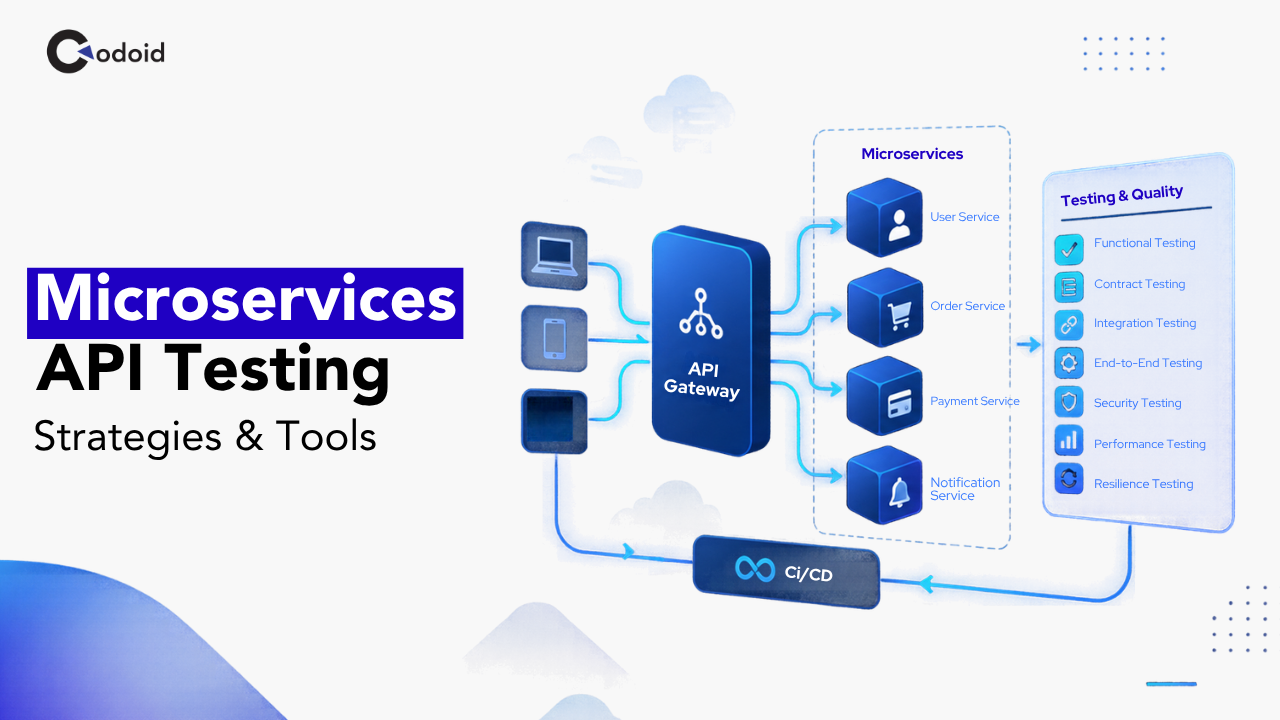
Microservices make applications easier to divide, deploy, and scale independently, but they also make microservices API testing more distributed. A user request may travel through an API gateway, several services, databases, queues, and third-party APIs before it completes. As a result, testing only individual HTTP endpoints is not enough. Teams need a layered API testing strategy that verifies each service independently while also checking the contracts, dependencies, failure modes, and end-to-end workflows connecting those services.
How should microservices APIs be tested?
Microservices APIs should be tested at multiple layers: service-level functional tests, contract tests, integration tests, end-to-end tests, security tests, performance tests, and resilience tests. The most effective strategy runs fast, isolated tests early in CI and reserves slower tests involving multiple real services for scenarios that genuinely require them. If you’d rather have a team build this out, our API and backend testing services team applies this exact layered approach to production microservices.
Key takeaways
- Test each microservice independently before testing complete workflows.
- Use contract testing to detect incompatible API changes between consumers and providers.
- Test critical integrations against realistic databases, brokers, and infrastructure rather than mocking every dependency.
- Cover authentication, authorization, malformed input, rate limits, and other security conditions explicitly.
- Define measurable performance thresholds instead of treating load tests as informational reports.
- Keep a small number of end-to-end tests for high-value business workflows and diagnose failures with distributed tracing.
Related Blogs
API Performance Testing: Response Time, Throughput, and Scalability
API Automation Testing with Postman, REST Assured, and Playwright: A Tester-Focused Guide
What is microservices API testing?
Microservices API testing is the process of verifying the behavior, compatibility, security, performance, and reliability of APIs used by independently deployable services.
The testing scope includes more than checking whether GET, POST, PUT, or DELETE requests return expected status codes. It may also cover:
- Request and response schemas
- Business rules
- Authentication and authorization
- Service-to-service contracts
- Database interactions
- Message queues and event streams
- Timeouts and retries
- Idempotency
- Rate limiting
- Error handling
- Performance under load
- Partial dependency failures
For HTTP APIs, an OpenAPI description can provide a machine-readable definition of endpoints, parameters, payloads, and responses. As of September 2026, OpenAPI Specification 3.2.0, released on September 19, 2025, is the latest published OAS version.
Microservices API testing vs. traditional API testing
Traditional API testing often focuses on whether a single API behaves correctly. Microservices API testing must additionally account for distributed ownership and independent change.
For example, an order service might depend on an inventory service whose team releases independently. Both services can pass their own functional tests while still failing together because one team changed a field name, response type, validation rule, or error structure.
That is why contract and integration testing become particularly important in microservice architectures.
Why does microservices API testing matter?
A microservice normally exposes only one part of a larger business operation. Failures can therefore originate far from the API that the client initially called.
Consider an e-commerce checkout:
Client
↓
API Gateway
↓
Order Service
|--------------------> Inventory Service
|
|--------------------> Payment Service
|
+--------------------> Event Broker ---> Shipping Service
A successful response from the order endpoint does not automatically prove that the system is correct. The order may have been stored while payment failed, inventory may have been reserved twice after a retry, or the shipping event may never have been published.
Distributed systems also make failures harder to diagnose because a single transaction crosses service and process boundaries. OpenTelemetry, for example, uses context propagation to correlate spans belonging to the same operation across services, making distributed traces particularly useful when debugging integration and end-to-end tests.
A comprehensive API testing strategy reduces the chance that independently correct services become collectively unreliable.
How does microservices API testing work?
An effective strategy divides testing into layers based on what needs to be proven and how many dependencies must be involved.
End-to-End Tests (fewest, highest cost)
↓
Integration / Workflow Tests
↓
Consumer Contract Tests
↓
Component / Service API Tests
↓
Unit Tests (most, lowest cost)
Tests nearer the bottom should generally be easier to isolate and run frequently. Tests nearer the top exercise more of the deployed system but introduce more moving parts, test data, infrastructure, and potential sources of failure.
The objective is not simply to maximize the number of tests. It is to place each risk at the lowest test layer capable of detecting it reliably.
1. Unit and component tests
Unit tests verify individual functions, classes, validators, or domain rules without network dependencies.
Component-level API tests run the microservice as a testable application while replacing selected external services. They can validate:
- Routing
- Serialization
- Input validation
- Error handling
- Business rules
- Authentication middleware
- HTTP status codes
These tests are useful for getting rapid feedback before infrastructure-heavy tests run.
2. Contract tests
Contract testing verifies that a service provider remains compatible with its consumers.
Pact describes a consumer-driven contract as an agreement in which the consumer records the interactions it requires and the provider verifies that it can satisfy them. Pact specifically distinguishes contract testing from provider functional testing: contract tests check shared assumptions rather than trying to test all provider behavior.
Contract tests are particularly useful when different teams independently deploy services.
For example, suppose the checkout service expects:
“productId”: “SKU-104”,
“available”: true,
“quantity”: 24
}
If the inventory service later renames available to inStock, its own tests might still pass. A consumer contract test can catch the incompatible change before deployment.
3. Integration tests
Integration tests verify that a service communicates correctly with real infrastructure or selected neighboring systems.
Typical dependencies include:
- PostgreSQL or MySQL
- Redis
- Kafka or RabbitMQ
- Object storage
- Identity services
- HTTP services
Testcontainers is designed for this category of testing. Its Java implementation creates lightweight, disposable instances of databases, message queues, web servers, and other containerized dependencies, allowing tests to begin from a known environment.
The point is not to start the entire production architecture for every integration test. Run only the dependencies required to verify the behavior under test.
4. End-to-end tests
End-to-end tests verify complete workflows across multiple deployed services.
Examples include:
- Register customer → authenticate → create order
- Add item → reserve inventory → collect payment
- Submit claim → validate policy → approve claim
- Create booking → charge card → send confirmation
These tests provide valuable confidence, but every participating service, dependency, network route, credential, and data store increases the number of possible failure causes.
Keep the suite focused on critical business journeys rather than duplicating every lower-level API scenario.
5. Performance tests
Performance tests establish how an API behaves under expected and exceptional traffic.
Useful measurements include:
- Request latency percentiles
- Throughput
- Error rate
- Saturation
- Dependency latency
- Timeout frequency
Performance tests become much more actionable when they have explicit acceptance criteria. Grafana k6 supports thresholds that turn metrics such as error rate and request duration into pass/fail conditions suitable for automated pipelines.
For example:
export const options = {
  thresholds: {
    http_req_failed: ['rate<0.01'],
    http_req_duration: ['p(95)<500']
  }
};
The exact thresholds should come from your own service objectives rather than arbitrary values copied from another system. Our performance testing services team typically defines these thresholds against your actual SLOs before load testing begins.
6. Security tests
Security testing must verify both technical vulnerabilities and API-specific access-control behavior.
The OWASP API Security Top 10 2023 identifies issues including broken object-level authorization, broken authentication, broken object-property authorization, unrestricted resource consumption, broken function-level authorization, server-side request forgery, and unsafe consumption of APIs.
Functional API suites should therefore include cases such as:
- Can User A retrieve User B’s object by changing its ID?
- Can a standard user call an administrator endpoint?
- Does an expired token still work?
- Can clients submit protected fields that should be server-controlled?
- What happens after repeated resource-intensive requests?
A 200 OK response does not prove an API is secure. Our security testing services team maps these API-specific checks directly to the OWASP API Security Top 10.
7. Resilience testing
Microservices must also behave predictably when dependencies are slow or unavailable.
Test conditions such as:
- Connection timeout
- Read timeout
- HTTP 500/503 responses
- Slow downstream responses
- Lost connections
- Duplicate events
- Broker unavailability
- Retry exhaustion
- Partial service degradation
A mock such as WireMock can return predefined responses and can also be used to reproduce controlled dependency behavior during testing. WireMock supports request matching and programmable HTTP stubs, along with features for simulating faults and stateful behavior.
Step-by-step: How to build a microservices API testing strategy
1. Map every service interaction
Start by identifying the boundaries around each microservice.
Document:
- Incoming API calls
- Outgoing API calls
- Databases
- Caches
- Message brokers
- Third-party services
- Authentication providers
- Events produced
- Events consumed
Why: You cannot select the correct testing layer until you know what the service depends on.
Expected result: A dependency map showing which interfaces can fail independently.
Common mistake: Documenting only public REST endpoints while ignoring service-to-service APIs and asynchronous events.
2. Establish machine-readable API contracts
Use OpenAPI for HTTP APIs where practical and Protocol Buffers for gRPC interfaces.
Define:
- Required fields
- Types
- Allowed values
- Response structures
- Error responses
- Authentication requirements
- Versioning rules
Why: A contract gives both humans and automated tooling a precise interface to validate.
Expected result: API implementation and test suites refer to a controlled source of interface truth.
Common mistake: Updating application code while leaving the published API specification unchanged.
3. Build service-level functional tests
Test the API’s own behavior before involving neighboring microservices.
Include:
- Valid requests
- Required-field validation
- Boundary values
- Malformed requests
- Unknown resource IDs
- Duplicate submissions
- Authentication failures
- Authorization failures
- Business-rule violations
- Expected error objects
Java teams can use REST Assured for code-based API assertions. Its current documentation shows REST Assured 6.0.1 as released on July 10, 2026.
An example test could look like this:
given()
    .contentType("application/json")
    .body("""
        {
          "customerId": "C-1024",
          "productId": "SKU-104",
          "quantity": 2
        }
        """)
.when()
    .post("/orders")
.then()
    .statusCode(201)
    .body("status", equalTo("PENDING"));
Add negative and boundary scenarios rather than stopping after the happy path.
4. Add consumer-provider contract verification
Identify APIs consumed by independently maintained applications or services.
For each important interaction:
- Record what the consumer actually requires.
- Produce the contract from consumer tests.
- Publish or share the contract.
- Verify it against the provider.
- Block incompatible provider releases.
Pact’s HTTP workflow follows this pattern: consumer tests generate a contract, the contract is shared, and provider verification replays the interactions against the provider.
Expected result: Breaking API changes fail before production deployment.
5. Test real infrastructure selectively
Replace mocks with real disposable infrastructure where implementation differences matter.
Use a real database when verifying:
- SQL behavior
- Transactions
- Migrations
- Constraints
- Index-dependent behavior
Use a real broker when verifying:
- Serialization
- Topics or queues
- Consumer configuration
- Delivery semantics
- Message metadata
Containerized environments are useful here because they provide controlled, repeatable dependencies without requiring a permanently shared integration environment.
6. Test asynchronous behavior explicitly
Event-driven microservices require a different assertion model from synchronous HTTP APIs.
Suppose:
POST /orders
       |
       +--> 202 Accepted
                 ↓
          OrderCreated event
                 ↓
           Inventory Service
Do not assume the downstream update exists immediately after receiving 202 Accepted.
Use bounded polling:
Create order
     ↓
Poll order state
     |
     +--> PENDING → retry
     |
     +--> CONFIRMED → pass
     |
     +--> REJECTED → evaluate scenario
     |
     +--> timeout → fail
Always impose a maximum waiting period. An unbounded sleep or polling loop hides failures and makes CI unpredictable.
7. Add security tests to normal CI
Security should not exist only as a late penetration-testing activity.
Automate checks for:
- Missing credentials
- Invalid credentials
- Expired tokens
- Role escalation
- Object-level access control
- Input manipulation
- Protected fields
- Unexpected HTTP methods
- Oversized requests
- Invalid content types
OWASP ZAP’s API scan can import OpenAPI, SOAP, or GraphQL definitions and perform API-oriented active scanning against discovered URLs. Because active scanning sends potentially hostile requests, run it only against systems where such testing is explicitly authorized.
8. Establish performance acceptance criteria
Identify the workload that represents the service’s expected operating conditions.
Then specify measurable criteria, for example:
Scenario: Create order
Traffic: expected peak profile
Error-rate requirement: < defined service target
p95 latency: < defined service target
Dependency timeout rate: < defined service target
Use thresholds so a regression can automatically fail the test stage rather than relying on someone to manually inspect charts.
9. Test dependency failures
For every significant synchronous dependency, test at least:
Successful response, business error, server error, timeout, invalid response, slow response, connection failure.
Also verify what your service does next:
- Does it retry?
- Is the retry bounded?
- Could it duplicate an operation?
- Does it return an appropriate error?
- Does it open a circuit breaker?
- Can it degrade gracefully?
Failure handling is part of the API contract users experience.
10. Gate releases at the appropriate CI stages
A practical pipeline might look like:
Commit
↓
Unit / Component Tests

Commit
↓
API Functional Tests

Commit
↓
Contract Verification

Commit
↓
Integration Tests
↓
Deploy Test Environment

Deploy Test Environment
↓
Critical Workflow Tests

Deploy Test Environment
↓
Security Scan

Deploy Test Environment
↓
Performance Smoke Test
↓
Release
Avoid running every expensive test on every code edit. Match execution frequency to the risk and cost of each test.
Related Blogs
Postman E2E API Testing: A Practical Guide for QA Teams
API and Backend Testing Services: Build Reliable, Secure Systems
Practical example: Testing an Order Service API
Consider an e-commerce Order Service.
Business scenario
A customer submits an order. The service must:
- Validate the order.
- Check inventory.
- Create the order.
- Publish an OrderCreated event.
- Return the new order ID.
Preconditions
Customer C-1024 exists. Product SKU-104 exists. Inventory = 10 units. Requested quantity = 2.
Request
POST /orders
Content-Type: application/json
Authorization: Bearer <token>

{
  "customerId": "C-1024",
  "items": [
    {
      "productId": "SKU-104",
      "quantity": 2
    }
  ]
}
Expected response
“orderId”: “ORD-9001”,
“status”: “PENDING”
}
Expected HTTP status: 201 Created
Recommended tests
| S. No | Test | What it proves |
|---|---|---|
| 1 | Valid order | Basic API behavior works |
| 2 | Quantity = 0 | Request validation rejects invalid input |
| 3 | Unknown product | Business error is handled |
| 4 | Missing token | Authentication is enforced |
| 5 | Another customer’s order ID | Object-level authorization is enforced |
| 6 | Inventory contract verification | Order Service and Inventory Service agree on the interface |
| 7 | Real database integration | Order persistence works with the actual database engine |
| 8 | Broker integration | OrderCreated is serialized and published correctly |
| 9 | Inventory timeout | Failure policy behaves correctly |
| 10 | Duplicate request with same idempotency key | Retry does not create duplicate orders |
| 11 | Peak workload | Latency and error-rate objectives hold under expected load |
Example failure condition
Assume the inventory service normally returns:
“productId”: “SKU-104”,
“availableQuantity”: 10
}
A provider deployment changes it to:
“productId”: “SKU-104”,
“stock”: 10
}
The inventory service might still pass its internal functional tests.
An Order Service consumer contract that requires availableQuantity, however, should fail provider verification and prevent the incompatible change from progressing.
That is exactly the type of failure contract testing is designed to detect.
Microservices API testing strategies compared
No single testing strategy covers every risk.
| S. No | Test type | Primary purpose | Real dependencies | Relative execution cost | Best use |
|---|---|---|---|---|---|
| 1 | Unit | Validate code logic | No | Low | Functions and domain rules |
| 2 | Component/API | Validate one service | Few or mocked | Low | Endpoint behavior and validation |
| 3 | Contract | Verify consumer/provider compatibility | Usually isolated | Low-medium | Independently deployed services |
| 4 | Integration | Validate actual integrations | Selected dependencies | Medium | Databases, brokers, infrastructure |
| 5 | End-to-end | Validate complete workflows | Many | High | Critical business journeys |
| 6 | Security | Find access-control and security weaknesses | Depends on scope | Medium-high | Security assurance |
| 7 | Performance | Validate capacity and latency objectives | Usually realistic environment | High | Release and capacity validation |
| 8 | Resilience | Validate failure behavior | Real or simulated failures | Medium-high | Timeouts, retries and degradation |
The right approach is therefore a portfolio of tests, not a choice between contract testing, integration testing, and end-to-end testing.

Ready to Close the Gaps in Your API Test Coverage?
Talk to Our API Testing TeamBest practices for testing microservices APIs
Keep service tests independently executable
A team should be able to test its service without starting the company’s entire platform. Isolation shortens feedback cycles and reduces failures caused by unrelated components.
Put compatibility checks before broad end-to-end tests
Use contract testing to detect service-interface incompatibilities close to the team introducing the change. This provides a more specific failure signal than discovering the same problem during a large multi-service test.
Test behavior, not just HTTP status codes
A response with 200, 201, or 204 may still contain incorrect data. Validate:
- Response schema
- Important field values
- Persistence
- Side effects
- Authorization
- Published events
- Downstream interactions
Use mocks deliberately
Mocks are valuable when the objective is to isolate a service or simulate rare failures. They are weak substitutes when the risk comes from a real implementation detail such as SQL behavior, broker configuration, serialization, TLS, or network communication.
Keep test data deterministic
A test should create or control the data it requires whenever feasible. Dependencies on long-lived shared test accounts and manually maintained database records frequently produce non-repeatable failures.
Test retries with idempotency in mind
A timeout does not always mean a downstream operation failed. For operations such as payments and order creation, verify that retries cannot unintentionally create duplicate business effects.
Make observability part of testability
Propagate trace context through synchronous and asynchronous service calls. Distributed traces help determine whether a failed workflow originated in the gateway, application logic, downstream service, database, or another dependency. OpenTelemetry defines context propagation specifically to correlate distributed operations across service boundaries.
Run tests at multiple lifecycle stages
Use fast functional and contract suites during pull requests, broader integration suites before deployment, and carefully controlled performance or security tests in suitable environments. Not every test needs the same trigger.
Common microservices API testing mistakes
| S. No | Mistake | Why it happens | Impact | Recommended fix |
|---|---|---|---|---|
| 1 | Testing only happy paths | Teams optimize for feature delivery | Error handling remains unverified | Add negative, boundary, and malformed-input tests |
| 2 | Relying entirely on end-to-end tests | They appear to test the “real system” | Slow, fragile feedback | Move checks to component, contract, and integration layers |
| 3 | Mocking every dependency | Isolation seems convenient | Integration incompatibilities remain hidden | Use real disposable infrastructure selectively |
| 4 | Ignoring API contracts | Teams coordinate changes informally | Independent releases break consumers | Add automated contract verification |
| 5 | Hard-coded sleeps | Async behavior is difficult to test | Slow and flaky suites | Use bounded polling based on observable state |
| 6 | Checking only status codes | Assertions are quick to write | Incorrect payloads or side effects pass | Validate schemas and business outcomes |
| 7 | Sharing mutable test data | Environment setup is centralized | Tests interfere with one another | Create isolated or uniquely identified data |
| 8 | Ignoring authorization scenarios | Authentication receives most attention | Cross-user or cross-role access can remain exposed | Add object- and function-level authorization tests |
| 9 | Running load tests without thresholds | Tests are treated as reports | Regressions do not block releases | Encode measurable acceptance criteria |
Why does an API test pass individually but fail in the full suite?
The most likely cause is shared mutable state or hidden test ordering. Check whether tests reuse the same customer, account, database row, queue, cache entry, token, or idempotency key. Generate unique test identifiers, reset state where appropriate, and make tests independent of execution order.
Why does a contract test fail even though the provider API works manually?
The consumer and provider may disagree about a detail that manual testing did not exercise. Compare required fields, data types, headers, status codes, nullability, error responses, and provider state. Avoid making contracts unnecessarily strict. Pact recommends contracts focus on interactions the consumer actually relies on rather than duplicating all provider functional behavior.
Why do microservices API tests fail intermittently?
Intermittent failures commonly originate from timing, asynchronous processing, shared data, dependency instability, or environmental contention. Correlate failures with traces and dependency logs before simply adding retries. Retrying the test can hide a genuine race condition.
Why does an asynchronous API test fail immediately after receiving a successful response?
A response such as 202 Accepted usually indicates that processing can continue after the HTTP request finishes. Verify completion through a business-visible state, event, or read endpoint and use bounded polling rather than expecting an immediate downstream update.
Why does the test environment behave differently from production?
The test environment may use different infrastructure, topology, configuration, authentication, resource limits, data volumes, or dependency versions. Compare the characteristics relevant to the failing scenario rather than assuming an environment is production-like merely because it uses the same application build.
Why does an API return 401 instead of 403?
A 401 Unauthorized response normally indicates that valid authentication is missing or unacceptable, while 403 Forbidden normally means the request was understood but access is not permitted. When testing authorization, first ensure the caller has valid credentials. Otherwise the test may exercise authentication rather than the permission rule it intended to verify.
Tools for microservices API testing
Tool selection should depend on the layer being tested rather than trying to standardize every API test on one platform.
| S. No | Tool | Good fit | Notes |
|---|---|---|---|
| 1 | Postman | Exploratory, functional, workflow and regression API testing | Collections can contain scripts and assertions and can run manually or through CI tooling. |
| 2 | REST Assured | Java API automation | Provides a fluent Java API for HTTP request and response assertions. |
| 3 | Pact | Consumer-driven contract testing | Generates consumer expectations and verifies provider compatibility. |
| 4 | WireMock | API mocking and fault simulation | Supports programmable stubs and request matching for controlled dependency behavior. |
| 5 | Testcontainers | Integration testing with realistic infrastructure | Creates disposable containerized databases, brokers, servers, and other dependencies. |
| 6 | k6 | Load and performance testing | Supports executable performance thresholds suitable for CI gates. |
| 7 | Schemathesis | Schema-driven and property-based API testing | Generates test cases from OpenAPI or GraphQL schemas and validates responses against the schema. |
| 8 | OWASP ZAP | Automated API security scanning | Its API scan supports definitions including OpenAPI and GraphQL. |
| 9 | OpenTelemetry | Diagnosing distributed test failures | Provides trace context propagation and distributed observability across services. |
A version-compatibility note for schema-based tools
Do not assume that every testing tool immediately supports the newest API specification, and re-check compatibility periodically since tool support changes. As of this writing, Schemathesis supports OpenAPI (Swagger) 2.0, 3.0, 3.1, and 3.2, alongside GraphQL schemas, so it has already caught up to the current OpenAPI 3.2.0 specification. Teams adopting a new OpenAPI version should still verify compatibility with their exact toolchain before upgrading specifications used by automated tests, since not every tool in a pipeline updates on the same schedule.
Limitations and risks of microservices API testing
A strong automated suite reduces risk but cannot prove that a distributed system will never fail. Several limitations remain.
Mocks can create false confidence. A mock reproduces the behavior you configured, not necessarily the behavior of the real dependency.
Shared environments create nondeterminism. Concurrent deployments, tests, and data changes can make failures difficult to reproduce.
End-to-end coverage becomes expensive. The number of possible service combinations, data states, and failure modes grows rapidly as architecture becomes more distributed.
Performance results are environment-dependent. A latency number measured in a small test cluster cannot automatically be treated as a production capacity guarantee.
Active security tests can be disruptive. Scanners may send malicious or resource-intensive requests and should be executed only in explicitly authorized environments.
Eventually consistent workflows need time-aware assertions. Treating every distributed update as immediate produces flaky tests and incorrect expectations.
The goal is therefore risk-based confidence, not an impossible promise that every combination has been tested.
Conclusion
Testing microservices APIs successfully requires more than sending requests to individual endpoints. The strongest approach is layered: validate service behavior locally, protect service boundaries with contracts, exercise important infrastructure through integration tests, verify critical workflows end to end, test authorization and failure handling explicitly, and use measurable performance criteria. Most importantly, put each test at the lowest layer that can detect the intended failure reliably. Doing so gives teams faster feedback without sacrificing the integration, security, performance, and resilience coverage that distributed architectures require.
A practical next step is to map one production-critical workflow, identify every service and dependency it crosses, and classify its current tests as functional, contract, integration, end-to-end, security, performance, or resilience. Missing categories reveal where the next testing investment is likely to provide the greatest value. Talk to our API testing team if you want help closing those gaps.
Frequently Asked Questions
-
What types of tests are most important for microservices APIs?
Functional, contract, integration, security, performance, resilience, and selected end-to-end tests address different risks. Contract tests are particularly valuable between independently deployed services, while integration tests are necessary where real databases, brokers, or protocols may behave differently from mocks. End-to-end tests should concentrate on critical business workflows rather than duplicating every service-level test.
-
What is the difference between contract testing and integration testing?
Contract testing verifies interface compatibility; integration testing verifies that components work together in a real or realistic integration. A contract test can prove that an Inventory Service still returns data required by an Order Service without starting the complete application. An integration test may start the service with its actual database, broker, or neighboring system to verify runtime communication.
-
Should microservices API tests use mocks or real services?
Use both according to the risk being tested. Mocks are appropriate for service isolation, deterministic errors, timeouts, and uncommon dependency conditions. Use real implementations when behavior depends on database semantics, message brokers, serialization, network protocols, authentication infrastructure, or other details a mock may not reproduce.
-
Should every microservice be included in end-to-end testing?
No. A complete all-services suite is not necessary for every API requirement. Use broad end-to-end tests for high-value business journeys, and verify most logic and compatibility at lower testing layers. This keeps failures easier to diagnose while still providing system-level confidence where it matters.
-
How should asynchronous microservices APIs be tested?
Assert against observable completion rather than assuming immediate consistency. After triggering an asynchronous operation, poll a status endpoint, observe an event, or query the resulting business state until the expected outcome appears or a defined timeout expires. Avoid fixed sleeps because processing time can vary across environments.
-
How do you test microservices API security?
Combine automated security scanning with explicit business-level authorization tests. Validate missing and invalid credentials, cross-user resource access, role restrictions, protected fields, resource consumption, unsafe input, and other relevant API risks. The OWASP API Security Top 10 is a useful threat-oriented starting point, but the test cases should be mapped to the application's actual authorization and business model.
-
What is the best tool for testing microservices APIs?
There is no single best tool because different tools solve different testing problems. Postman and REST Assured suit functional automation, Pact targets consumer-driven contracts, Testcontainers supports realistic integration environments, WireMock supports dependency simulation, k6 targets performance testing, and ZAP supports security scanning. Select tools according to the test layer and the technology stack your team maintains.
































Comments(0)