



























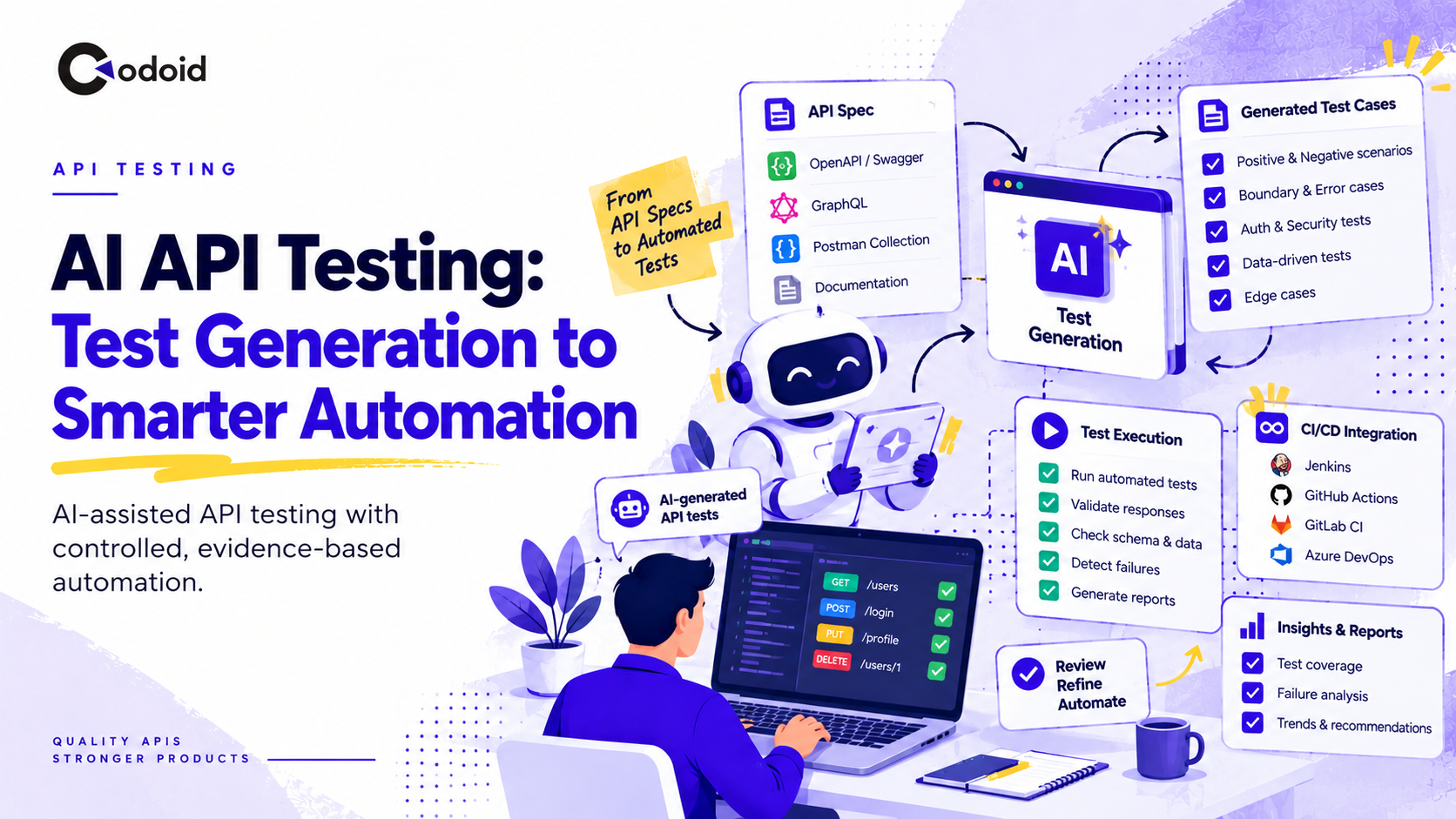
AI API testing starts from a hard truth: an API can return the expected status code, satisfy its response schema, and still behave incorrectly. Imagine an order service that creates two orders when a client retries the same request. Both responses contain valid JSON. Both include legitimate order IDs. A test that checks only the status code and response structure may pass, even though the business operation has been duplicated. Now imagine the opposite problem: hundreds of tests fail because a shared authentication fixture expired. The application may be healthy, but engineers must still separate the underlying setup failure from its downstream symptoms.
These examples illustrate three useful places to apply AI to API testing specifically: deciding what to test, interpreting failures, and coordinating automation. If your team is testing distributed services more broadly, see our related guide on microservices API testing strategy for the layered testing approach this AI layer sits on top of.
Related Blogs
API Automation Testing with Postman, REST Assured, and Playwright: A Tester-Focused Guide
API Performance Testing: Response Time, Throughput, and Scalability
How should AI be used in API testing?
The engineering challenge is to gain AI’s capabilities without surrendering control over correctness. AI should propose scenarios and explanations; explicit contracts, approved business rules, and executable assertions should determine pass or fail. Our API and backend testing services team applies this same hybrid model, using AI to widen coverage while keeping every pass/fail decision anchored to a reviewed assertion.
Automated test generation is not inherently AI-driven. Schemathesis generates property-based tests from API schemas, while Microsoft’s RESTler infers dependencies between operations and explores stateful request sequences. These approaches already provide capabilities beyond manually scripted examples.
Language models introduce another mechanism: interpreting descriptive context and proposing domain-relevant combinations. Research systems such as AutoRestTest combine language models with dependency graphs and reinforcement learning rather than relying on unconstrained text generation alone.
A practical implementation should follow the same hybrid principle:
| S. No | Activity | Useful AI contribution | What should remain explicit |
|---|---|---|---|
| 1 | Test case generation | Interpret requirements and propose scenarios, data variations, and workflows | Supported operations, fixtures, expected behavior, and safety limits |
| 2 | Failure analysis | Organize evidence, suggest related failures, and rank hypotheses | Observed results, evidence references, and confirmation checks |
| 3 | Automation | Recommend test priorities and maintenance changes | Mandatory coverage, execution permissions, and approval rules |
The goal is not to replace the test framework with a conversational model. It is to place a controlled reasoning layer around established testing infrastructure.
1. Test Case Generation: From API Descriptions to Meaningful Coverage
Ground generation in authoritative context
An OpenAPI description provides a machine-readable starting point: operations, parameters, request bodies, responses, and security requirements. It gives a generator a defined interface to work with instead of requiring it to invent one.
For a useful generation workflow, supplement that interface with approved business rules, authorization policies, fixture definitions, and existing regression tests.
Consider a hypothetical order API. Its relevant context might establish that:
- Quantity must be an integer between 1 and 10.
- Repeating an identical creation request with the same idempotency key must not create another order.
- Customers cannot read another tenant’s orders.
- An order can be cancelled only before shipment.
These rules describe different dimensions of correctness. A request schema can express the quantity constraint, but the generator also needs the approved meaning of an idempotent retry and the permitted lifecycle transitions.
Keep this context versioned. Retrieve documentation for the API revision under test, and record which requirement supports each proposed assertion. When documentation and implementation disagree, report the conflict rather than silently selecting whichever behavior makes the test pass.
Observed behavior is evidence about the system, not automatically the definition of correct behavior.
Generate a coverage model before generating scripts
A useful first output is a scenario matrix, not a directory full of test files.
For the hypothetical order API, ask the model to propose coverage across several dimensions:
| S. No | Coverage dimension | Example scenario | Required oracle |
|---|---|---|---|
| 1 | Valid boundaries | Create orders with quantities 1 and 10 | Both values are accepted under the documented contract |
| 2 | Invalid inputs | Submit 0, 11, null, or a string quantity | The documented validation error occurs without creating an order |
| 3 | Authorization | Read a real order using another tenant’s identity | Access is denied according to the approved policy |
| 4 | Stateful behavior | Create, cancel, then retrieve an order | The persisted state reflects the permitted transition |
| 5 | Idempotency | Repeat an identical request with the same key | The same logical order is returned without duplicate creation |
| 6 | Concurrency | Submit overlapping requests with the same key | The documented duplicate-handling invariant holds |
| 7 | Metamorphic behavior | Change page size while reading a fixed collection | The complete result set remains equivalent under a stable snapshot |
Authorization deserves explicit treatment. OWASP describes broken object-level authorization as a failure to verify whether the authenticated user may act on the particular object identified in a request, not merely whether that user can access the endpoint.
For that reason, pair a negative authorization test with a positive control: first establish that the resource exists and its owner can read it, then attempt access using a different identity. Otherwise, a missing fixture could produce a denial response and create false confidence.
Similarly, stateful tests should obtain real resource identifiers from earlier responses instead of guessing them. Schemathesis documents this approach by chaining operations and using response values as inputs to subsequent calls.
Use AI to propose meaningful relationships. Let the runner manage identifiers, credentials, setup, and cleanup.
Keep the test oracle independent
A test oracle is the mechanism that decides whether an observed result is correct.
An AI-generated request without a defensible oracle is an experiment, not yet a reliable regression test.
Use different checks for different questions. Schema validation checks response structure. Business assertions check rules such as “a cancelled order cannot transition to shipped.” State inspection checks whether a failed request created unwanted records. Consumer-driven contracts check interactions that actual clients depend on; Pact, for example, generates contracts from consumer tests and verifies those expectations against providers.
When an exact expected response is unavailable, consider an approved invariant or metamorphic relation. For example, changing pagination size should not change the complete collection returned under the same stable snapshot.
However, the model must not invent that relation. Pagination behavior, ordering guarantees, consistency windows, and filtering rules must support it.
A particularly dangerous workflow is to show the model the application’s current response and ask it to generate the expected response for the same test. That can turn an existing defect into an approved expectation.
Prefer constrained test plans over arbitrary executable code
Instead of immediately requesting Python or JavaScript, ask the model for a declarative plan using an approved vocabulary.
A generation instruction could be:
Using only the supplied API operations, fixtures, and requirement IDs, propose tests for uncovered behavior. Select approved execution templates and assertion references. Do not invent expected status codes. Mark scenarios with missing requirements as unresolved.
An illustrative output might be:
{
"case_id": "order-replay-boundaries",
"operation_id": "createOrder",
"template": "repeat_create_then_query",
"fixture": "isolated_tenant_with_stock",
"parameters": {
"quantity": [1, 10]
},
"assertion_refs": ["ORDER-IDEMPOTENCY-001"],
"source_refs": [
"openapi@api-revision:createOrder",
"order-rules@rules-revision:ORDER-IDEMPOTENCY-001"
]
}
Validate more than JSON syntax. Confirm that the operation exists, the fixture is available, the template permits the requested action, and the assertion reference resolves to an approved rule.
Also distinguish plan validation from API-input validation. Negative tests intentionally contain invalid API inputs. Rejecting every payload that violates the API schema would eliminate precisely the cases a negative-testing workflow needs.
The model proposes the plan; a controlled compiler or reviewed implementation turns it into executable tests.
A practical example: testing idempotent order creation
The following example implements the proposed replay scenario using pytest and HTTPX. Pytest parametrization runs the same behavior against multiple inputs, while an HTTPX client provides shared request configuration and connection management.
This is an illustrative API contract, not a universal definition of idempotency: the first POST /orders returns 201 with a string id. An identical request using the same Idempotency-Key, within its retention window, returns 200 with that same ID. A filtered GET /orders provides a read-after-write-consistent result containing items and total.
The CI environment must provision an isolated tenant, a scoped token, and an in-stock SKU. It must also destroy the tenant after the run, including when tests fail.
# test_orders.py
import os
from collections.abc import Iterator
from uuid import uuid4

import httpx
import pytest


@pytest.fixture
def api() -> Iterator[httpx.Client]:
    required = ("API_TEST_BASE_URL", "API_TEST_TOKEN", "TEST_SKU")
    missing = [name for name in required if not os.getenv(name)]
    if missing:
        pytest.fail(f"Missing test configuration: {', '.join(missing)}")
    with httpx.Client(
        base_url=os.environ["API_TEST_BASE_URL"],
        headers={
            "Authorization": f"Bearer {os.environ['API_TEST_TOKEN']}"
        },
        timeout=httpx.Timeout(10.0, connect=3.0),
        follow_redirects=False,
    ) as client:
        yield client


@pytest.mark.parametrize(
    "quantity",
    [1, 10],
    ids=["minimum-quantity", "maximum-quantity"],
)
def test_create_order_is_idempotent(
    api: httpx.Client,
    quantity: int,
) -> None:
    reference = uuid4().hex
    headers = {"Idempotency-Key": uuid4().hex}
    payload = {
        "sku": os.environ["TEST_SKU"],
        "quantity": quantity,
        "client_reference": reference,
    }
    first = api.post("/orders", json=payload, headers=headers)
    assert first.status_code == 201, (
        f"Initial creation returned {first.status_code}"
    )
    order_id = first.json()["id"]
    assert isinstance(order_id, str) and order_id
    replay = api.post("/orders", json=payload, headers=headers)
    assert replay.status_code == 200, (
        f"Replay returned {replay.status_code}"
    )
    assert replay.json()["id"] == order_id
    listing = api.get(
        "/orders",
        params={"client_reference": reference},
    )
    assert listing.status_code == 200
    result = listing.json()
    assert result["total"] == 1
    assert len(result["items"]) == 1
    assert result["items"][0]["id"] == order_id
    assert result["items"][0]["quantity"] == quantity
With the environment configured, run it using:
python -m pip install pytest httpx
python -m pytest -q test_orders.py
Pin dependencies in the project’s lockfile when adopting the example.
Notice what the test does, and does not, establish. It checks both response identity and the visible number of persisted orders. It does not prove that inventory was reserved only once or that a downstream event was emitted only once. Those effects require additional observers and assertions.
It also tests sequential replay, not overlapping requests. Concurrency testing needs a separate scenario with controlled overlap and its own evidence collection.
Finally, HTTPX’s connect, read, write, and pool timeouts are operation-specific limits, not a complete wall-clock deadline for the test suite. Configure a separate CI execution deadline.

Ready to Add AI to Your API Testing Without Losing Control?
Talk to Our API Testing Team2. Failure Analysis: From Error Messages to Evidence-Backed Hypotheses
Generating tests is only part of the problem. The next challenge is explaining what a failure actually means.
Related cloud-incident research provides a useful architectural example: RCACopilot combines runtime diagnostic collection with language-model-based categorization and explanations. Its results concern cloud incidents, however, and should not be assumed to transfer directly to a particular API test suite.
For API testing, build an evidence-first workflow rather than asking a model to diagnose an isolated stack trace.
Create a structured failure bundle
Before invoking AI, collect the test and requirement revisions, expected and actual results, sanitized request details, fixture identity, execution attempt, deployment version, and relevant diagnostic references.
Include distributed traces when available. OpenTelemetry defines standard HTTP attributes such as http.request.method, http.response.status_code, and the server-side route template http.route, which can provide consistent fields for comparing failures across services.
Keep the bundle focused. A specific assertion, its request sequence, and the relevant downstream spans are generally a better input design than an unrestricted dump of unrelated logs.
Also preserve the distinction between a response and a transport failure. “The API returned an unexpected status” and “the client never received a response” require different investigations.
Separate observations from interpretation
An analysis result should distinguish established facts, hypotheses, alternative explanations, and the next checks needed to discriminate between them.
Suppose a follow-up investigation of the order test produces this illustrative report:
Observed: Two requests used the same tenant, payload, and idempotency key. Both returned 201, with different order IDs. A subsequent state query found two orders.
Hypothesis: The second request bypassed or failed the deduplication lookup.
Alternative explanations: The requests reached instances with inconsistent configuration, or the server calculated different internal key scopes.
Next checks: Compare the computed deduplication keys, inspect the relevant request paths, and repeat against a controlled deployment configuration.
This is useful because every proposed explanation has a verification path.
By contrast, “the cache is broken” is not a root-cause analysis unless the evidence establishes that conclusion.
Require references to the trace, log event, assertion, or configuration supporting each factual observation. Allow the model to return “insufficient evidence.” A confidence number should not replace missing diagnostics.
Group failures without merging unrelated defects
Use deterministic attributes for initial grouping: the violated invariant, normalized exception frames, operation, failing dependency, and deployment revision.
AI can then suggest broader relationships, for example, that several apparently different failures may share an authentication setup problem. Verify those proposed groups against the underlying evidence before treating them as one defect.
Avoid grouping by status code alone. Two 500 responses may have different causes, while a single dependency failure may produce timeouts, validation failures, and unexpected empty responses across the suite.
The same discipline applies to flaky tests. A passing retry does not prove the original failure was harmless. Preserve the first result and investigate whether controlled reruns implicate timing, shared state, infrastructure, or a genuine race condition.
Reduce failures into reproducible regressions
After identifying a meaningful failure, reduce the request sequence and payload while preserving the same violated invariant.
AI can suggest which fields or steps appear unnecessary. The runner must confirm that removing them still reproduces the original failure, not merely some other error.
Save the resulting test artifact, fixture recipe, request sequence, environment revision, and relevant random seeds. Preserve generated identifiers as diagnostic evidence, while recreating valid resources during replay.
The desired output is not just a readable explanation. It is a small, reviewable regression test and enough evidence for an engineer to act.
3. Smarter Automation: Prioritization, Maintenance, and Controlled Execution
The third opportunity is to improve how the suite operates without allowing AI to redefine its obligations.
Prioritize tests using change and risk
Build a mapping between tests, operations, shared schemas, authorization components, and downstream dependencies. Use that mapping to identify which tests a change may affect.
An AI-assisted scheduler can propose priorities using change relevance, business impact, previous defect history, and estimated runtime. Treat those priorities as recommendations within explicit coverage rules.
For example, make critical smoke, authorization, and core lifecycle tests mandatory. Run affected dependency and contract tests next. Reserve a fixed exploration budget for scenarios that the prioritizer did not select, and retain broader scheduled runs.
When dependency metadata is missing, expand execution rather than silently assuming an operation is unaffected.
Do not optimize exclusively around previously failing tests or frequently observed traffic. That would make rare workflows and previously unseen defects easy to neglect.
Make maintenance reviewable, not self-concealing
AI-assisted maintenance should produce a proposed patch with a reason, a supporting requirement, and a visible assertion diff.
Updating a fixture to match an approved request-field change is different from weakening an assertion because the implementation changed unexpectedly.
For example, changing:
assert response.status_code == 403
to:
assert response.status_code in (200, 403)
may make a test pass while removing its ability to detect unauthorized access.
Require review for changes to authorization expectations, accepted status codes, required fields, side-effect checks, and business invariants. Preserve the original failing result so the proposed repair can be evaluated against it.
A green pipeline is not evidence of correctness when the system is allowed to relax its own expectations.
Keep generation separate from routine execution
A practical architecture is:
Versioned API specifications, rules, and fixture definitions
↓
AI-generated test plan
↓
Structural, semantic, and policy validation
↓
Reviewed test artifact
↓
Isolated test runner
↓
Sanitized evidence bundle
↓
AI triage and maintenance suggestions
↓
Reviewed regression update
This separation keeps model availability out of the critical path for already-approved regression tests.
Generate or revise tests when requirements change. Run the saved artifacts normally. Invoke AI analysis for new or meaningfully changed failure groups rather than repeatedly submitting identical failures.
Use deterministic logic where it is sufficient. A model does not need to calculate minimum minus 1 or enumerate a small declared enum. Spend model calls on ambiguous prose, cross-operation relationships, and domain-specific scenarios.
For performance testing, keep workload definitions and acceptance thresholds explicit as well. AI may summarize a latency change or suggest an investigation, but it should not independently redefine a service-level target or excuse a failing result.
Related Blogs
Protect the Testing System Itself
An AI-assisted testing pipeline has its own trust boundaries.
API descriptions, response bodies, issue comments, and logs may contain untrusted text. OWASP identifies indirect prompt injection through external content and recommends controls including tool-call validation, least privilege, and human approval for sensitive actions.
Apply those controls outside the model. Restrict execution to approved origins and operations. Keep credentials in the runner rather than in prompts. Cap request volume, concurrency, and resource creation. Do not give generated plans unrestricted shell access or production-wide permissions.
Sanitize data before it enters prompts, retrieval indexes, or stored analysis artifacts. OpenTelemetry’s HTTP conventions recommend explicit configuration of captured headers, and its URL conventions require scrubbing known sensitive query parameters. Those are useful foundations for a deliberately limited diagnostic bundle.
Maintain an audit trail connecting each generated test to its source revisions, generation configuration, approved assertions, and reviewer. The same traceability should apply to AI-proposed maintenance patches.
Measure Defect Detection, Not Generated Test Volume
Evaluate the addition of AI against a meaningful baseline: the existing suite plus conventional schema-based or property-based testing.
Use historical defective builds, controlled fault injection, and held-out incidents. Keep incident resolutions out of the triage model’s input when evaluating whether it can diagnose those incidents.
Useful measures include:
| S. No | Measure | What it reveals |
|---|---|---|
| 1 | Executable, applicable proposals divided by all proposals | Whether generation produces usable scenarios rather than merely valid-looking output |
| 2 | Confirmed new defects per fixed execution and review budget | Whether the AI layer adds value beyond existing coverage |
| 3 | Detection of eligible seeded faults or mutants | Whether generated assertions respond to deliberately introduced defects |
| 4 | Correct triage recommendations, alongside abstention rate | Whether explanations are actionable and appropriately cautious |
| 5 | Reproduction and flaky-failure rates | Whether results remain dependable across controlled runs |
| 6 | End-to-end cost and time to an actionable diagnosis | Whether operational gains outweigh model and review overhead |
Deduplicate defects rather than counting every failing request as a discovery. Include rejected and unexecutable proposals in generation-quality measurements.
Evaluate generation and diagnosis separately. A system may propose useful tests while producing weak explanations, or diagnose failures well while adding little new coverage.
Start with reviewed test proposals and non-blocking triage suggestions. Expand automation only after measuring their performance on the actual service, and repeat the evaluation when models, prompts, or retrieval logic change.
Conclusion
AI API testing is most useful when it helps engineers ask better questions and work through evidence more effectively. For test case generation, ground proposals in versioned contracts, business rules, and realistic workflows. For failure analysis, require observations, evidence references, competing hypotheses, and reproducible checks. For smarter automation, use AI to recommend priorities and maintenance changes while keeping coverage obligations, permissions, and assertions under explicit control.
The strongest outcome is not the largest generated test suite. It is a collection of meaningful tests whose failures are reproducible, whose expectations are defensible, and whose results engineers can trust. Talk to our API testing team if you want help building this into your own pipeline.
Frequently Asked Questions
-
What is the safest way to use AI for API test case generation?
Ground generation in a versioned OpenAPI description plus approved business rules, authorization policies, and fixtures, rather than letting the model invent its own interface. Ask for a declarative test plan referencing approved operations and assertion IDs first, and let a controlled compiler or reviewed implementation turn that plan into executable tests.
-
Why shouldn't AI generate the expected result from the application's current response?
If a model is shown the application's current output and asked to produce the "expected" value for that same test, it can turn an existing defect into an approved expectation. Expected results should come from approved examples, independently reviewed calculations, or a trusted reference implementation instead.
-
How should AI be used to analyze API test failures?
Build an evidence-first workflow: collect a structured failure bundle (request details, fixture identity, deployment version, distributed traces) before invoking AI, then require the analysis to separate established facts from hypotheses and alternative explanations, each with a verification path. Allow the model to say "insufficient evidence" rather than forcing a confident-sounding guess.
-
Can AI safely rewrite or relax a failing test's assertions?
Only under review. Changing an assertion like status_code == 403 to status_code in (200, 403) can make a test pass while removing its ability to detect unauthorized access. AI-assisted maintenance should produce a proposed patch with a reason and a visible assertion diff, not silently weaken the check to get a green pipeline.
-
What security risks does AI introduce into an API testing pipeline?
API descriptions, response bodies, and logs can contain untrusted text that attempts indirect prompt injection. Controls like tool-call validation, least-privilege execution, keeping credentials in the runner rather than in prompts, and requiring human approval for sensitive actions should be enforced outside the model, not requested from it.
-
How do you measure whether AI is actually improving an API test suite?
Track confirmed new defects found per execution and review budget, the rate of executable versus rejected proposals, detection of seeded faults or mutants, and reproduction and flaky-failure rates, evaluated against a baseline of the existing suite plus conventional schema-based testing. Generated test volume alone is not a useful measure.
































Comments(0)